

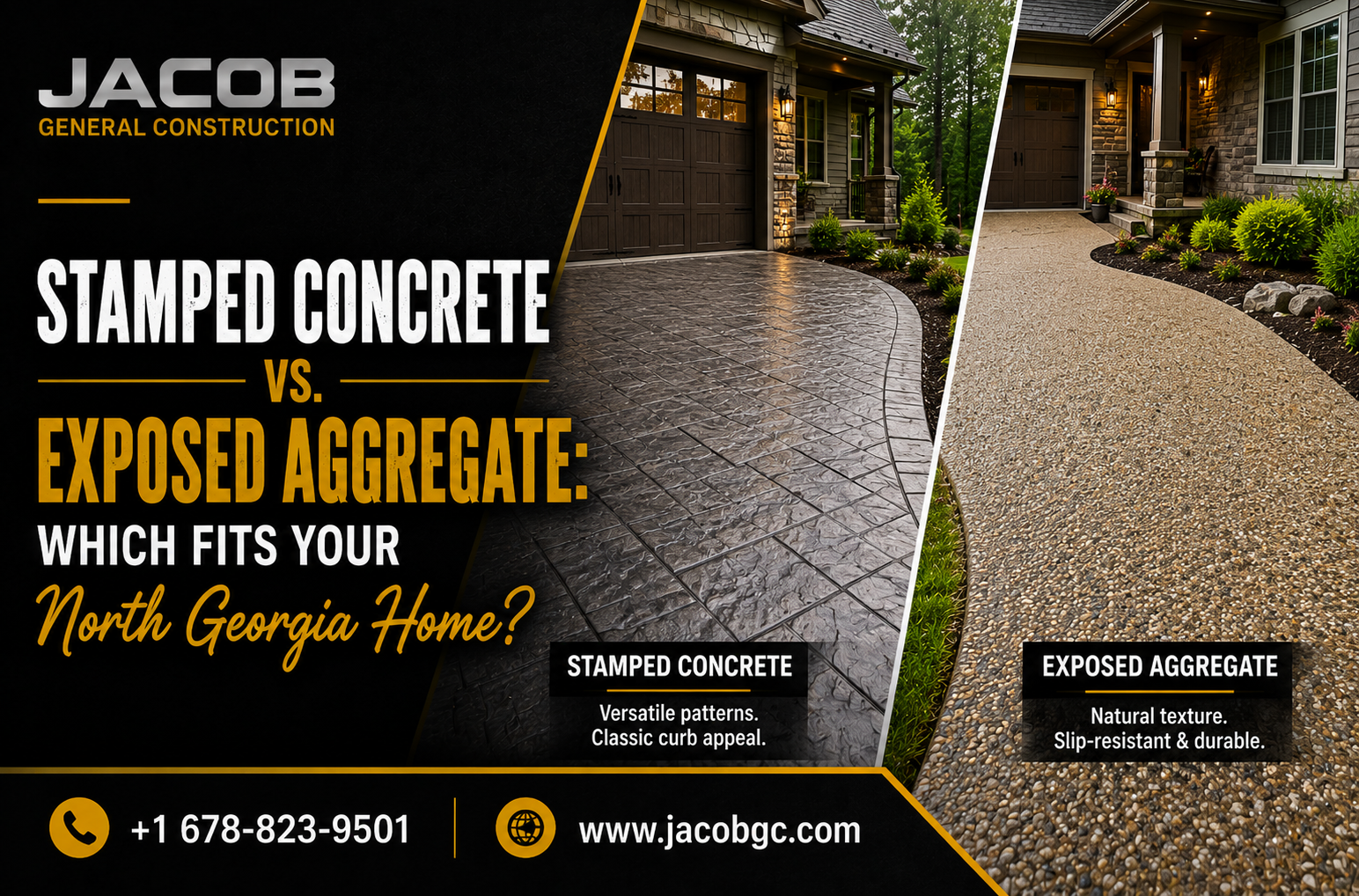
Two of the most popular decorative concrete options for North Georgia homeowners — stamped concrete and exposed aggregate — deliver very different looks, textures, and price points.
Stamped concrete vs exposed aggregate
Both are far more durable and lower-maintenance than natural stone or pavers, but choosing between them comes down to your home’s style, your budget, and how the surface will be used. Here’s a real comparison to help you decide.
What Is Stamped Concrete?
Stamped concrete uses textured mats pressed into the surface before it fully cures, replicating the look of natural stone, brick, slate, or wood at a fraction of the cost of the real material. Color is typically added through integral color, surface staining, or a combination of both, and the finished surface is sealed to protect the color and texture.
What Is Exposed Aggregate?
Exposed aggregate concrete is created by washing away the top layer of cement paste before it fully cures, revealing the decorative stones mixed throughout the concrete. Rather than an applied pattern, the texture comes from the stone aggregate itself, giving it a naturally rugged, speckled appearance.
Side-by-Side Comparison
| Factor | Stamped Concrete | Exposed Aggregate |
|---|---|---|
| Look | Mimics stone, brick, slate, or wood in a defined pattern | Natural, speckled texture from visible stone aggregate |
| Style fit | Traditional, craftsman, formal outdoor spaces | Modern, rustic, or natural landscape settings |
| Slip resistance | Good, if properly sealed with anti-slip additive | Excellent — one of the most slip-resistant finishes available |
| Cost | Higher (more labor-intensive process) | Moderate (less labor than stamping, but pricier aggregate options exist) |
| Maintenance | Requires resealing every 2–3 years to maintain color and pattern | Requires resealing but generally more forgiving if maintenance is delayed |
| Best use | Driveways, patios, and walkways where a specific pattern or stone look is desired | Sloped driveways, pool decks, and areas where traction is a priority |
Which Is Better for a Sloped North Georgia Driveway?
This is where the two options diverge most for local homeowners. North Georgia’s hilly terrain means a lot of driveways have real grade to them, and exposed aggregate generally provides superior traction compared to a stamped surface — even a well-sealed one. If your driveway has a noticeable slope, exposed aggregate is often the safer long-term choice.
Which Looks Better with a Brick or Stone Home?
Stamped concrete has the advantage here, since it can be patterned and colored to directly echo your home’s brick or stone exterior — a running bond brick pattern next to a brick home, for example, creates a cohesive, intentional look. Exposed aggregate offers a more neutral, natural texture that complements a home without necessarily matching it stone-for-stone.
Cost Considerations
Exposed aggregate is generally less labor-intensive to install than stamped concrete, since it doesn’t require pattern-stamping tools or as much detail work — though costs rise if you choose premium or decorative aggregate stone. Stamped concrete’s cost comes primarily from the labor of stamping, coloring, and detailing the surface to accurately replicate the target material.
Both options cost more than a standard broom-finished slab, but significantly less than installing real stone or brick pavers over the same area.
Maintenance Realities for Both
- Both need periodic resealing — typically every 2–3 years — to protect against North Georgia’s humidity, UV exposure, and freeze-thaw cycles in winter.
- Exposed aggregate is more forgiving if resealing is delayed, since the color comes from the stone itself rather than a surface treatment.
- Stamped concrete’s appearance depends more on sealant condition, since fading or wear is more visible on a patterned, colored surface than on natural stone texture.
Can You Combine Both?
Yes — many North Georgia homeowners use exposed aggregate for a sloped driveway section where traction matters most, and stamped concrete for a flat front walkway or patio area where the decorative pattern has more visual impact. This lets you optimize for both safety and style in different areas of the property.
Top 7 Proven Stamped Concrete vs Exposed Aggregate Tips in North Georgia
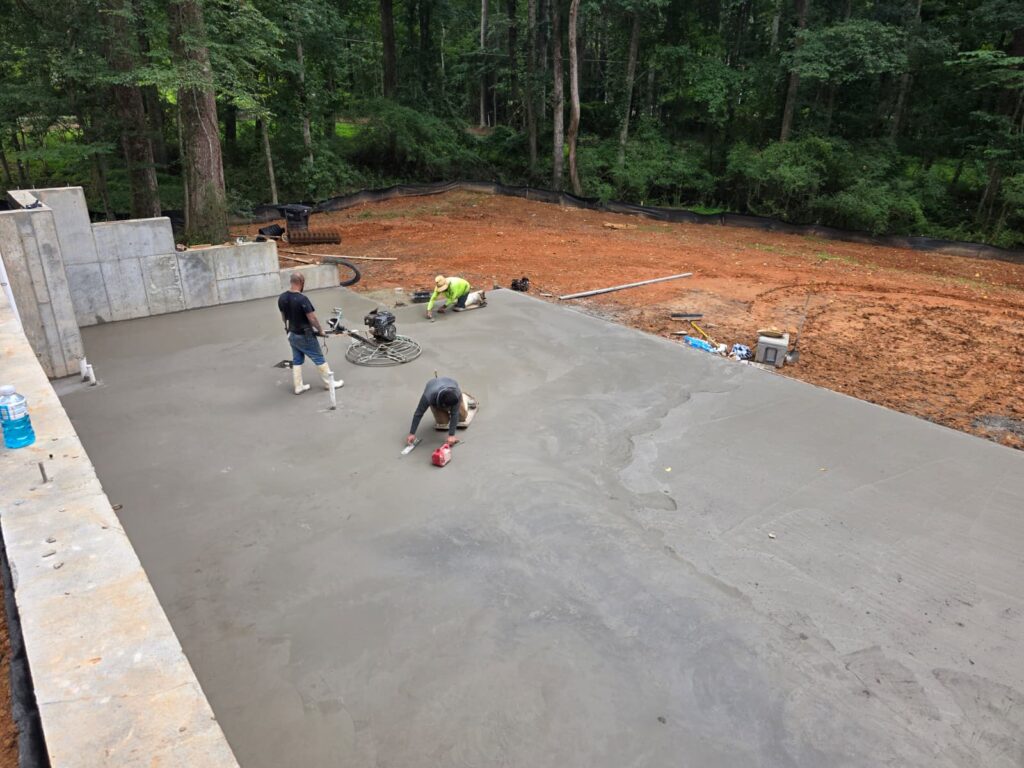
Upgrading a residential driveway, backyard patio, or front entryway across North Georgia offers homeowners an exciting opportunity to boost curb appeal and long-term property value. When moving beyond plain broom-finished cement, the debate of stamped concrete vs exposed aggregate stands out as the top choice for durable decorative flatwork. Both finishes outperform loose gravel or individual stone pavers in longevity and weed resistance, yet they deliver completely different textures, slip resistance levels, and maintenance schedules.
At Jacob General Construction, we combine over 15 years of civil engineering, land development, and heavy excavation expertise to pour decorative flatwork built for Georgia’s climate. Whether you are evaluating stamped concrete vs exposed aggregate for a steep hillside entrance or designing a backyard entertainment space, our in-house crews manage everything—from raw land clearing and laser-guided grading plans to aggregate base compaction and precision pouring.
Section 1: Understanding Stamped Concrete vs Exposed Aggregate
Before comparing contractor quotes or reviewing a concrete driveway cost north georgia guide, it helps to understand how each decorative finish is created during the pouring process. Evaluating stamped concrete vs exposed aggregate starts with looking at surface aesthetics, raw ingredients, and finishing methods.
How Stamped Concrete Works
Stamped concrete replicates the upscale appearance of natural flagstone, slate, cobblestone, brick, or weathered wood planks. Crews add integral color pigments directly into the ready-mix truck or broadcast color hardeners across the wet surface. Before the cement fully cures, technicians press heavy-duty textured polyurethane mats into the slab, stamping deep, realistic patterns. Finally, a high-gloss or matte acrylic sealer is applied to lock in rich tones and protect against UV rays.
How Exposed Aggregate Works
Rather than pressing an artificial pattern onto the surface, exposed aggregate reveals the natural beauty hidden inside the concrete mix itself. Crews incorporate decorative stones—such as smooth river stone, riverstone, or colorful pea gravel—directly into the upper concrete layer. Once the slab reaches a specific firmness, technicians apply a surface retarder and gently wash away the top film of cement paste, exposing a rugged, slip-resistant stone texture.
Direct Side-by-Side Breakdown
- Visual Aesthetic: Stamped concrete replicates brick, slate, ashlar stone, or wood planks in structured patterns, whereas exposed aggregate creates a natural, organic speckled stone surface using washed pea gravel or river stone.
- Slope and Wet Traction: When comparing stamped concrete vs exposed aggregate on inclines, stamped finishes offer moderate traction and require silica grit additives in the sealer, while exposed aggregate delivers superior natural traction and ranks as one of the safest slip-resistant concrete finishes available.
- Color Longevity: Stamped surfaces rely on topical sealers and stains that can fade if resealing is delayed, while the natural stone colors in exposed aggregate never fade under intense North Georgia summer sun.
- Installation Labor: Stamped finishes require higher labor intensity due to coloring, stamping mats, and hand detailing, whereas exposed aggregate requires moderate labor focused on precise timing for washing away the top paste cleanly.
- Long-Term Upkeep: Evaluating stamped concrete vs exposed aggregate for maintenance shows that stamped concrete must be cleaned and resealed every 2 to 3 years to prevent color wear, while exposed aggregate is very forgiving and only needs resealing every 3 to 5 years.
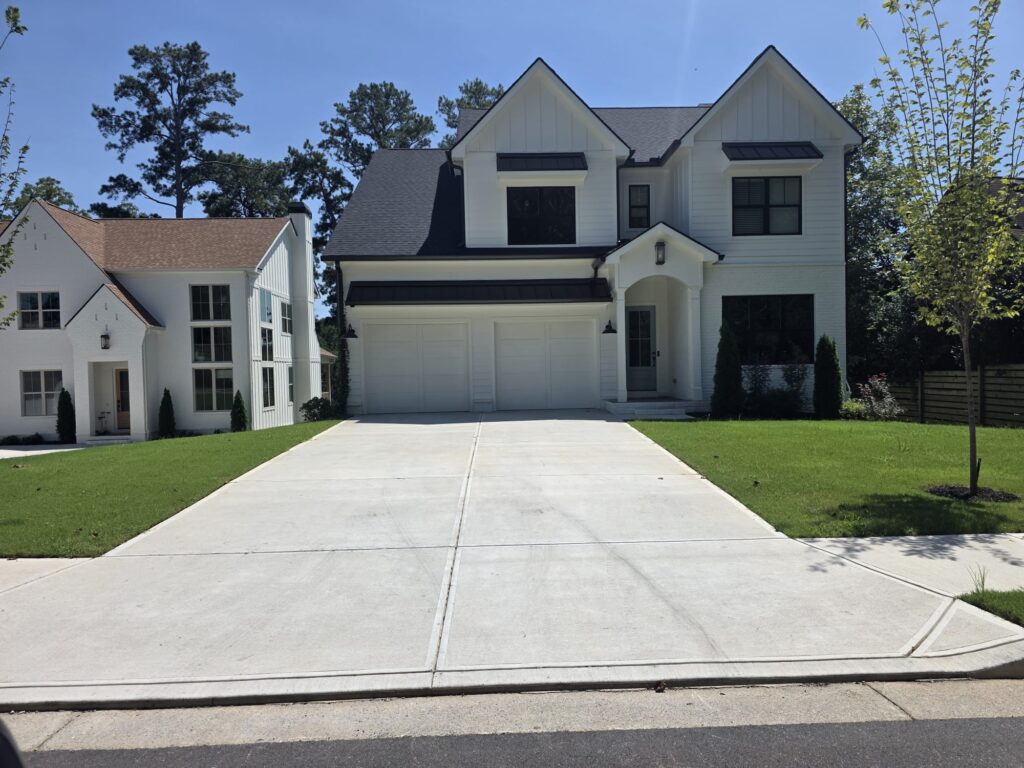
Section 2: Traction & Safety on Sloped North Georgia Driveways
When weighing stamped concrete vs exposed aggregate in Metro Atlanta, topography is often the deciding factor. North Georgia’s rolling foothills mean many residential driveways feature steep inclines, sharp curves, and shaded sections that stay damp after spring storms.
Why Slope Grade Dictates Your Finish Choice
- Steep Driveway Approaches: Smooth stamped patterns coated with high-gloss sealers can become slick during heavy rain or winter frost. Even with anti-slip grit mixed into the sealer, exposed aggregate provides vastly superior tire grip and pedestrian traction on steep grades.
- Flat Patios and Entry Walkways: On level ground—such as a front concrete walkway, pool deck, or covered backyard patio—the visual elegance of stamped concrete vs exposed aggregate often tips toward stamping, allowing you to match your home’s brick or stonework seamlessly.
- Hybrid Design-Build Layouts: Many property owners combine both options on the same lot—pouring exposed aggregate along a steep driveway approach for safety while transitioning to a stamped concrete apron or courtyard near the front door. Understanding how stamped concrete vs exposed aggregate performs on varying inclines lets you design a layout that balances safety and architectural style.
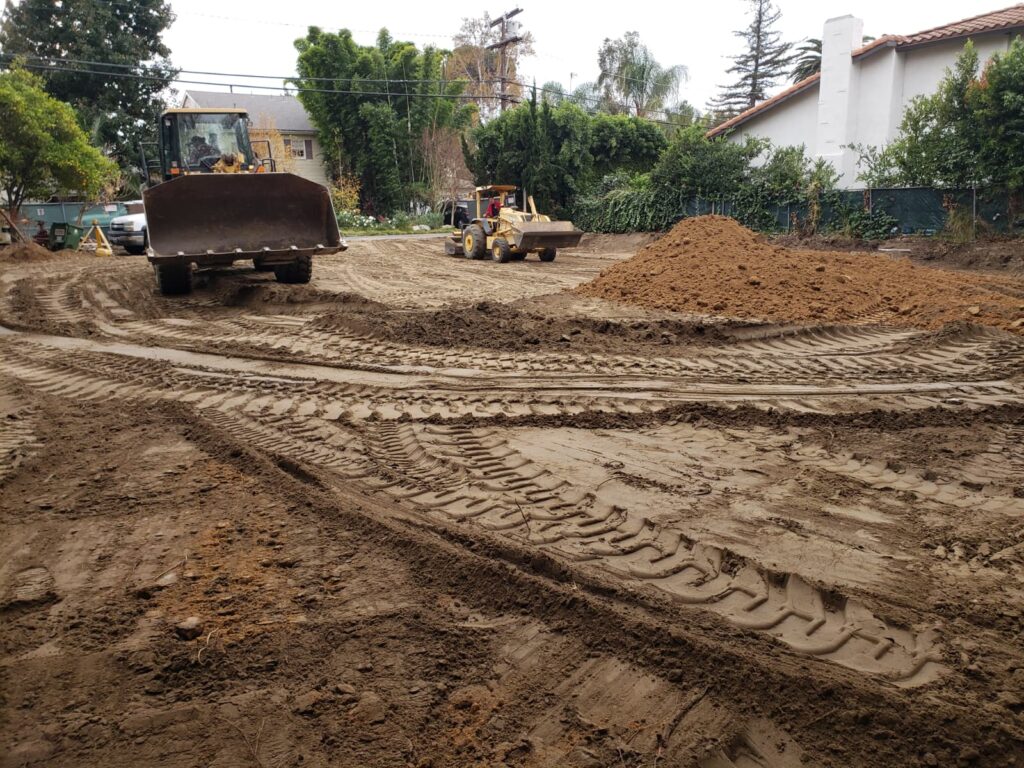
Section 3: Heavy Clearing, Logging, and Site Preparation
No matter which side of the stamped concrete vs exposed aggregate debate you choose, your decorative slab will crack and settle if poured over poorly prepared ground. Every successful hardscape project starts with thorough clearing and earthwork.
Site Clearing, Grading, and Structural Preparation
Proper execution of either stamped concrete vs exposed aggregate requires rigorous site preparation to prevent settling or structural shifting over North Georgia’s expanding red clay.
- Land Clearing & Mulching: Operations begin with commercial logging, tree felling, and on-site chipping to convert brush into functional groundcover or erosion-control mulch.
- Stump Removal & Compaction: Subterranean roots and stumps are fully grubbed out to eliminate voids and sinkholes. Excavators remove old pavement and lay down multi-layered aggregate bases (sub-base sand, crusher run, and #57 stone) compacted to a 95% Standard Proctor density. For rural properties, secondary gravel access roads can smoothly transition into your primary stamped concrete vs exposed aggregate entryways.
- Drainage & Stormwater Engineering: Custom interceptors—such as engineered swales, concrete trench drains, and sub-surface French drains—are integrated prior to pouring to prevent standing water and soil washout.
- Geotechnical & Septic Coordination: In areas like Alpharetta, Milton, and surrounding counties, soil surveys, perc tests, and utility line sleeving ensure decorative slabs maintain safe clearance from septic tanks, drain fields, and underground lines without compromising your stamped concrete vs exposed aggregate layout.
Pouring, Curing, and Regional Compliance
Once base work and utility verifications are complete, structural forms and #4 steel rebar are installed. Crews apply either interlocking polyurethane texture mats with color hardeners or seed decorative river stone with a surface retarder. Control joints are saw-cut every 8 to 12 years to manage natural curing stress, followed by specialized sealers.
Upfront costs average $12.50 to $17.00+ per square foot for exposed aggregate and $15.00 to $22.00+ per square foot for stamped concrete, with maintenance schedules varying between 2–3 years for stamped surfaces and 3–5 years for exposed aggregate. Adherence to regional municipal codes across Alpharetta, Roswell, Milton, Woodstock, Fulton, Cherokee, Forsyth, and Gainesville ensures every stamped concrete vs exposed aggregate installation meets local watershed and zoning standards.
Section 11: Design Customization, Color Palettes, and Architectural Pairing
When homeowners evaluate stamped concrete vs exposed aggregate, visual flexibility often plays a major role in matching the exterior architecture of a North Georgia residence. Both finishes transform ordinary gray cement into custom hardscaping, yet they achieve aesthetic harmony in completely different ways.
Customizing Stamped Concrete Patterns and Colors
Stamped concrete offers virtually unlimited design freedom. By combining base integral colors with secondary antiquing release agents, skilled finishers replicate the exact shade variations found in natural Georgia fieldstone, antique red brick, or rustic timber planks. Homeowners with traditional brick estates in Alpharetta or Milton frequently choose ashlar slate or running-bond brick stamp patterns to mirror their home’s masonry façade. You can even stamp contrasting decorative borders along the edges of a patio or walkway to frame outdoor living spaces cleanly.
Selecting Natural Stone Blends for Exposed Aggregate
In contrast, evaluating stamped concrete vs exposed aggregate for organic, modern, or rustic mountain homes often highlights the natural elegance of exposed stone. Rather than relying on artificial pigments, exposed aggregate gets its color directly from the raw minerals mixed into the concrete. Property owners can select warm brown river pebbles, speckled granite chips, quartz aggregates, or colorful pea gravel blends that complement surrounding wooded landscapes and natural stone retaining walls without looking manufactured.
Section 12: Weather Resistance, Freeze-Thaw Cycles, and Pool Deck Comfort
North Georgia experiences intense summer heat, high humidity, torrential spring rainstorms, and occasional winter freezes. Understanding how stamped concrete vs exposed aggregate reacts to these seasonal extremes helps you pick the most comfortable and durable surface for specific areas of your yard.
Performance Around Swimming Pools and Patios
- Barefoot Comfort and Heat Retention: Dark-colored stamped concrete patterns can absorb significant heat under direct July sunlight, making them warm on bare feet around swimming pools. Lighter natural stone blends used in exposed aggregate reflect more sunlight, though the bumpy stone texture feels firmer underfoot compared to smooth-troweled stamped slate.
- Chlorine and Saltwater Exposure: Pool chemicals and winter de-icing salts can gradually wear down topical sealers. When comparing stamped concrete vs exposed aggregate for pool surrounds, both require a high-grade breathable penetrating sealer to prevent moisture intrusion and surface scaling during winter freeze-thaw cycles.
- Snow Shoveling and Winter Care: Smooth stamped surfaces allow plastic snow shovels to glide easily without catching, whereas the raised stone texture of exposed aggregate requires careful shoveling and strictly avoiding metal-edged blades or harsh rock salt during rare Georgia ice storms.
Section 13: Repairability, Resurfacing, and Long-Term Lifespan
Every exterior concrete installation eventually faces minor wear over decades of vehicle traffic and weather exposure. Knowing the difference between stamped concrete vs exposed aggregate when repairs become necessary ensures there are no surprises years down the road.
Patching and Restoring Decorative Finishes
If a heavy utility truck cracks a corner or tree roots lift a section of pavement, matching existing decorative concrete requires skilled craftsmanship:
- Repairing Stamped Concrete: Blending a fresh patch into an older stamped slab can be challenging because UV exposure slightly alters surface stain colors over time. Experienced finishers must carefully match the original stamp texture mat and custom-tint topical stains to camouflage the repair seamlessly.
- Repairing Exposed Aggregate: Patching exposed aggregate relies on sourcing the exact same size and color blend of decorative river stone or pea gravel used in the original pour. Once washed and sealed, the natural stone texture helps hide repair seams effectively.
Ultimately, comparing stamped concrete vs exposed aggregate comes down to balancing visual style, slope safety, and long-term maintenance habits. Whether you want the classic architectural patterns of stamped masonry or the rugged, slip-resistant durability of natural stone aggregate, Jacob General Construction delivers precision site prep and expert finishing across North Georgia. Call our team today at 678-823-9501 to discuss your design goals and schedule a free on-site consultation!
Frequently Asked Questions
Which is more slip-resistant on a hill: stamped concrete or exposed aggregate? Exposed aggregate generally offers better natural traction than stamped concrete, making it a stronger choice for sloped North Georgia driveways, even when the stamped surface is properly sealed with an anti-slip additive.
Is exposed aggregate cheaper than stamped concrete? In most cases, yes, since it typically requires less labor than the stamping and detailing process — though the cost gap narrows or reverses if you choose premium decorative aggregate stone.
Does stamped concrete crack more than exposed aggregate? Both finishes are equally susceptible to cracking based on the same underlying factors — soil movement, slab thickness, and proper base preparation — rather than the surface finish itself.
Can exposed aggregate be stained for more color options? Yes, though it’s less common than with stamped concrete, since the visual appeal of exposed aggregate typically comes from the natural stone color rather than an applied stain.
Which option adds more resale value to a North Georgia home? Both are considered upgrades over standard broom-finished concrete and are generally viewed favorably by buyers. Stamped concrete tends to have broader visual appeal for buyers focused on curb appeal, while exposed aggregate appeals to buyers prioritizing durability and low maintenance.
Let’s Help You Decide
At Jacob General Construction, we install both stamped concrete and exposed aggregate surfaces throughout North Georgia, and we’ll walk your property with you to recommend the option that actually fits your slope, style, and budget — not just the trendiest choice.
Not sure which finish is right for your home? Contact Jacob General Construction for a free consultation and estimate.
Explore our complete range of structural, paving, and site preparation solutions by visiting our Our Services page. You can also review official transportation and construction-related guidelines through the Georgia Department of Transportation (GDOT) website.
Article Comments (0)