
Septic Systems Built to Last
From design to final inspection, we install septic systems that work the way they should — the first time, and for years to come.
Call Us Now: 678-823-9501
Service Details
A septic system is one of the most important — and most permanent — investments you’ll make in a property that isn’t connected to municipal sewer. Get it right, and you won’t think about it for years. Get it wrong, and you’re looking at backups, soggy yards, and expensive repairs down the road. Jacob General Construction has more than 15 years of experience designing and installing septic systems for homeowners, builders, and property owners across North Georgia, and we treat every install like it has to work for decades — because it does.
Septic work isn’t one-size-fits-all. The right system for your property depends on your soil, your lot size, your household’s needs, and what your local health department requires. We’ve installed everything from traditional gravel systems to more advanced chamber and infiltrator systems, so we can recommend what actually fits your site instead of pushing a single solution on every job.
What Our Septic Service Includes
We handle septic work from the ground up, whether you’re building new, replacing a failing system, or adding onto an existing setup. Our septic services include:
- Septic system design based on soil and site conditions
- Percolation (perc) testing coordination
- New septic system installation for new construction
- Septic tank installation and replacement
- Drain field / leach field installation
- Traditional gravel septic systems
- Chamber and infiltrator septic systems
- Aerobic treatment system (ATS) installation
- Septic system repair and replacement
- Permitting and coordination with local health authorities
- Grading and site prep tied directly into your septic layout
Because grading is part of our core business, we don’t just drop a tank in the ground — we make sure the surrounding site is graded correctly so water drains away from your drain field instead of into it. That coordination between grading and septic work is one of the biggest things that separates a system that lasts from one that doesn’t.
Why Proper Septic Installation Matters
A septic system that’s installed correctly protects your property, your health, and your wallet. Undersized tanks, poorly placed drain fields, or systems that don’t match the soil conditions are some of the most common reasons septic systems fail early — and failures aren’t cheap to fix once wastewater starts backing up into your yard or your home.
Soil type matters more than most people realize. North Georgia’s clay-heavy soil doesn’t drain the way sandy or loamy soil does, which means a system that works fine on one lot can fail on the lot next door. That’s why we don’t guess — we look at your specific soil and site conditions and design or recommend a system built for those conditions, not a generic one.
For new construction, septic design also has to work with your home’s layout, your driveway, your grading plan, and your local permitting requirements from day one. Getting the septic plan right early avoids costly redesigns and delays later in the build.
Our Septic Installation Process
We start with a site visit to evaluate your soil, lot size, and layout, and to understand whether you’re building new, replacing an existing system, or adding capacity. If a PERC test is needed, we coordinate that as part of the process.
From there, we design or recommend a system that fits your property and meets local health department requirements — whether that’s a traditional gravel system, a chamber system, or an aerobic treatment system for a more challenging site. We handle the permitting process and make sure everything is approved before we break ground.
Once the plan is approved, we install the tank, drain field, and all related components, grading the surrounding area as needed so the finished site drains correctly. Before we consider the job done, we confirm the system passes inspection and walk you through how to care for it going forward.
Types of Septic Systems We Install
- Traditional gravel septic systems — the most common and cost-effective option for many standard lots
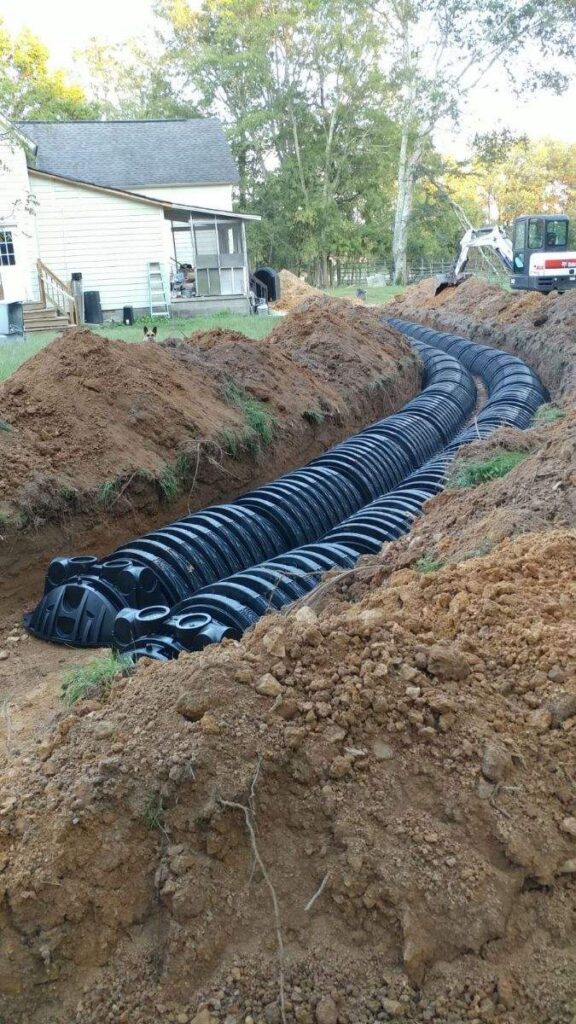
- Chamber / infiltrator systems — a modern alternative to gravel systems, often used where gravel isn’t practical or available
- Aerobic Treatment Systems (ATS) — used on smaller lots, poor soil conditions, or where a standard drain field won’t meet requirements
- Repair and replacement systems — for failing or aging septic systems that need to be brought up to current standards
We’ll walk you through which option makes sense for your property, your budget, and your household size — no one-size-fits-all recommendations.
Common Septic Projects
- New septic system installation for new home construction
- Septic system replacement for failing or outdated systems
- Septic installation for additions, ADUs, or secondary structures
- Drain field replacement or expansion
- Septic system design for lots with difficult soil conditions
- Coordinating septic layout with grading and driveway plans
What Sets Us Apart
Jacob General Construction has installed septic systems across North Georgia for more than 15 years, and we treat every property owner like a neighbor, not just a job number. We work directly with homeowners, and we’re just as happy handling a single-system install for a family home as we are working alongside builders on new construction.
Because septic, grading, and concrete work all fall under one company with us, your septic system doesn’t get installed in a vacuum. We look at how it fits with your site’s grading, your driveway, and your overall property plan — which means fewer conflicts, fewer surprises, and a system that’s set up to perform well for the long haul.
Local Septic Installation in North Georgia
Based in Milton, GA, Jacob General Construction has spent over 15 years working with the soil conditions, terrain, and permitting requirements found throughout North Georgia. We know what tends to work well here and what doesn’t, and we bring that experience to every septic design and install we take on.
Top 7 Proven Septic Tank Pumping Services in Alpharetta GA
A premium residential property or large-scale commercial installation in North Georgia requires an expertly engineered wastewater infrastructure. When developing land outside municipal utility networks, establishing a highly reliable septic system is paramount. Long-term property value, environmental hygiene, and mechanical safety depend entirely on foundational structural choices made during initial land development phases. For custom builders, residential developers, and property managers across Metro Atlanta, booking regular maintenance and scheduling expert septic tank pumping services shields foundational assets against premature failures, structural backups, and costly regulatory penalties.
At Jacob General Construction, we combine high-capacity excavation fleets with a deep technical mastery of civil engineering, soil dynamics, and environmental site design. From the initial level 3 soil survey and laser-guided grading plans down to the mechanical positioning of advanced sub-surface vaults, our turn-key ground engineering ensures absolute code compliance, outstanding operational lifespans, and fast project turnarounds.
Section 1: Heavy Land Clearing & Structural Site Prep
Every successful ground engineering operation begins by converting raw, wooded acreage into a clean, uniform structural grid. Before deploying subterranean concrete vaults or setting precise pipe channels, the plot must undergo mass clearing, grubbing, and earthwork to form a stable sub-grade base.
Advanced Site Prep, Civil Engineering, and Septic Balance
Initial land development across Fulton, Cherokee, and Forsyth county citation zones involves heavy tree felling, industrial chipping, and complete root grubbing to eliminate underground voids and prevent sinkholes. Following clearing, certified level III soil surveys and formal septic perc tests in georgia evaluate soil absorption rates and groundwater levels to guide engineering design.
A successful wastewater configuration relies on balancing the primary anaerobic containment tank with a secondary absorption field. Regular septic tank pumping services every three to five years prevent sludge from escaping into the sub-surface drain field, where layers of pea gravel, sand, and soil microbes naturally filter treated effluent.
Precision Earthwork, Drainage, and Hardscaping
Heavy earthwork requires multi-layer mechanical compaction using tandem truck fleets to deliver crushed aggregates and establish stable 95% Proctor density sub-bases. Comprehensive drainage solutions—including custom swales, French drains, and trench drains filled with #57 stone—mitigate standing water and protect local water quality.
Our turn-key site services extend to structural grading, concrete slab-on-grade foundations, driveways, retaining walls, and deep sub-surface utility installations for water, sewer, gas, and electrical conduits.
Section 2: Long-Term Maintenance and Structural Preservation
Ensuring the continuous operational health of a commercial or large-scale residential wastewater network demands a strict preventative maintenance framework. Neglecting the buildup of solid waste within the primary containment vault directly causes the entire underground grid to destabilize. When sludge and scum layers grow too dense, they escape past the internal baffles, flowing directly into the absorption trenches. This results in severe soil clogging, expensive system failures, and immediate environmental hazards that require immediate intervention.
The Critical Role of Routine Maintenance Logs
Securing professional septic tank pumping services at regular, calculated intervals is the single most effective way to guarantee drain field longevity. Over years of consistent daily use, non-biodegradable solids accumulate at the bottom of the concrete septic tank, steadily reducing its total operational liquid capacity. If this solid layer is not systematically extracted by certified vacuum tanker trucks, it forces raw, unfiltered effluent out into the specialized pea gravel and #57 stone filtration beds.
Once fine organic solids enter the subterranean absorption trenches, they form an impermeable biological mat that completely stops the ground’s natural drainage capability. By establishing a dedicated schedule for professional septic tank pumping services, property managers can easily monitor sludge accumulation levels, protect their initial infrastructure investment, and keep the entire system running at peak biological efficiency.
Safeguarding Sub-Surface Wastewater Infrastructure
A high-performing septic system requires perfect subterranean balance to filter domestic waste safely without disrupting the local environmental water quality. Heavy structural loads overhead, localized earth shifting, or severe weather conditions can compromise buried utility conduits, sewer line networks, and structural septic riser connections.
During comprehensive maintenance evaluations, certified technicians look beyond the primary tank layout to verify the mechanical stability of the central distribution box, checking that flow levels split evenly across parallel gravel-free chamber systems. Booking comprehensive septic tank pumping services gives operators an excellent opportunity to run complete fluid backflow tests, clean internal sanitation filters, and verify that heavy-wall electrical conduit lines driving effluent pump tank systems remain perfectly secure against deep soil moisture.
Section 10: Advanced Diagnostics & Structural Optimization
When managing complex drainage issues or resolving localized standing water problems around a buried drain field, deploying advanced diagnostic tools saves thousands of dollars in unnecessary mass excavation work. Modern ground engineering teams use down-hole pipe cameras and digital tracking equipment to isolate structural blocks long before bringing heavy bulldozers, dump trucks, or equipment rental track loaders on-site.
Diagnosing Backups and Absorption Field Failure
When internal plumbing fixtures begin to drain slowly or clear signs of ponding water show up on the surface layout, identifying the root cause demands immediate technical analysis. A failing sub-surface absorption network can easily be mistaken for a simple pipe block. Property owners should immediately schedule professional septic tank pumping services to drop the internal liquid levels within the vault, allowing a clear view of the structural inlet and outlet tees.
If the primary concrete septic tank fills back up from the field trenches immediately after being completely emptied, it indicates that the secondary soil profile is fully saturated with water. This clear indicator proves that the native loam or clay layers can no longer handle the property’s daily water volume.
Remediating Saturation and Optimizing Soil Fields
If a comprehensive level 3 soil survey shows that your absorption beds are installed within heavy, slow-draining North Georgia clay, standard gravity drainage layouts are prone to early saturation. To properly optimize a saturated septic system, crews can install advanced aggregate bases, add deep French drain channels to route surface stormwater away, or expand the absorption field footprint with high-capacity plastic infiltrators.
Integrating a custom-engineered pump tank setup allows for pressurized, even distribution across the entire drain field layout. This ensures that the effluent breaks down biologically without over-saturating a single trench. Combined with reliable, professional septic tank pumping services to keep solid waste completely clear of the distribution pipes, these structural upgrades help restore natural soil porosity, maximize filtration performance, and protect the property’s long-term environmental safety.
Section 11: Emergency Protocols & Turn-Key Solutions
Encountering a sudden wastewater backup during peak business hours or heavy storm events requires an immediate, structured emergency plan. Operating an overfilled subterranean network without fast professional help can cause wastewater to back up directly into low-elevation building structures, creating immediate biohazards and violating strict local health department codes.
Resolving Urgent System Backups and Overflows
Property managers must act quickly when a system warning alarm sounds or when surface soil conditions around the absorption pad become muddy and soft. The first step is to drastically reduce all internal water usage to prevent further pressure on the subterranean network, followed by calling for emergency septic tank pumping services. High-capacity vacuum pumpers can clear out the entire 1500 gallon tank or 2000 gallon tank vault in minutes, relieving hydrostatic pressure across the property and stopping immediate surface overflows.
Once the primary vault is cleared, field supervisors can safely inspect the layout to find out if the emergency was caused by a mechanical pump failure, a crushed sewer line, or an overloaded distribution box. Relying on trusted, professional septic tank pumping services ensures that emergency cleanups are handled safely, cleanly, and in total compliance with all local city of alpharetta citation and fulton county citation environmental rules.
Turn-Key Ground Engineering by Jacob General Construction
At Jacob General Construction, we engineer complete, long-lasting underground infrastructure solutions designed to perform reliably for decades. We look at your property as a whole system, making sure your underground septic system works in perfect harmony with your surface concrete driveways, structural pathways, mono slab foundations, and overall grading plan.
Explore our complete range of structural, paving, and site preparation solutions by visiting our Our Services page. You can also review official transportation and construction-related guidelines through the Georgia Department of Transportation (GDOT) website.
Request Your Free Septic Estimate
Whether you’re building new, replacing a failing system, or just want a second opinion on a septic quote, we’re happy to take a look at your property. Call Jacob General Construction at 678-823-9501 to schedule your septic estimate today.


