


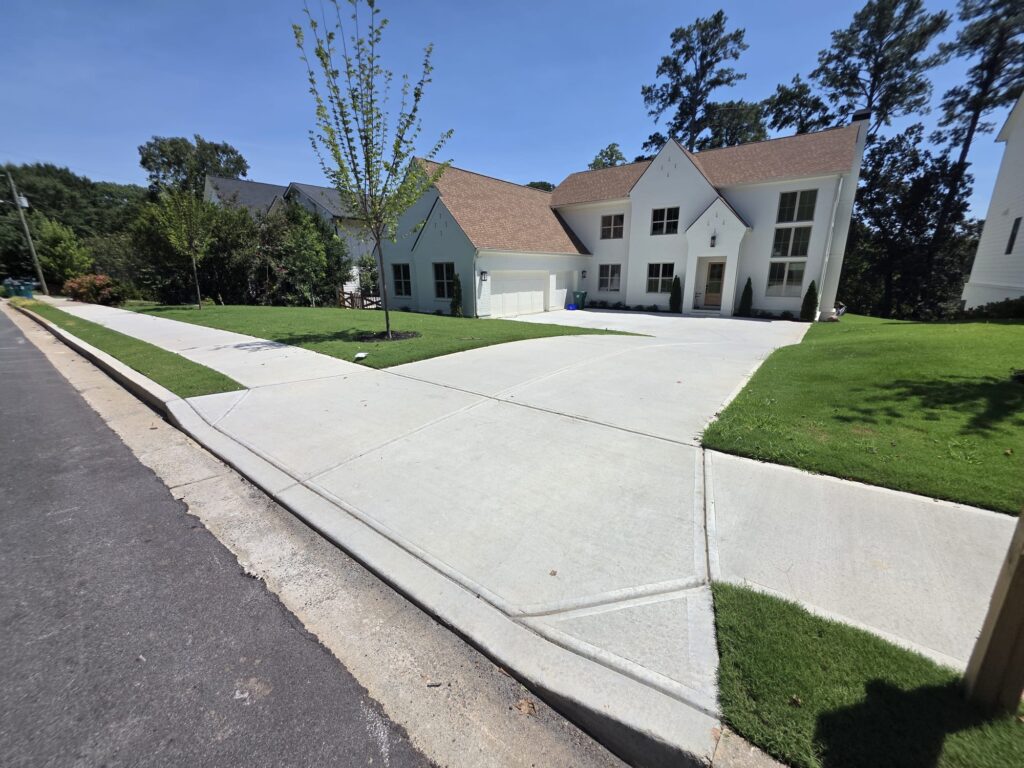
If you are looking for concrete driveway installation then you are on right place, driveways in Milton are not quite like driveways in a typical suburban subdivision. Larger lots, longer approaches, rolling terrain, mature trees, and properties on septic systems all change how a driveway should be planned and built. A design that works for a short, flat driveway may not work at all on a long, sloped one.
This guide covers the issues that matter most for Milton homeowners considering a concrete driveway, from drainage and underground systems to joint layout, delivery, and permits. When you are ready to plan your project, learn more about our concrete service in Milton, GA.
Milton Driveways Are Different
Milton is known for larger lots and a more spread-out feel, and that shows up in the driveways. Many homes sit well back from the road, so driveways can be long. Properties often include slopes, gates, mature trees, and outbuildings that the driveway needs to reach.
Longer and steeper driveways make the details more important. Small mistakes in grade, drainage, or joint layout get multiplied across a large surface, and repairs are costly.

Start With Drainage and Grade
On a long driveway, water is your biggest challenge. Rain that runs down a slope can build speed and volume, undermine the edges of the slab, and erode the soil beside it. The driveway needs to be graded so water leaves the surface in a controlled way rather than pooling in low spots or rushing toward the house, the garage, or a neighbor’s property.
That often means combining concrete work with careful grading. Concrete should be poured with a slope that drains properly, and the surrounding ground should be shaped to carry runoff away. A contractor who understands both grading and concrete will plan the two together.
Watch Out for Septic Systems and Underground Utilities
Many Milton properties rely on septic systems, and this is one of the most overlooked issues in driveway planning. Loaded concrete trucks and heavy equipment are extremely heavy, and driving them over a septic tank, distribution box, or drain field can crush or damage components that are expensive to replace.
Before work begins, locate the septic system and mark it so equipment stays clear. Underground utilities also need to be identified, and it is standard practice to call 811 before any digging. Sharing your septic layout and any known utility locations with your contractor early helps avoid costly mistakes.
Tree Roots and Existing Landscaping
Mature trees are one of the things that make Milton properties attractive, but their roots can disrupt concrete. Roots growing under a slab can lift and crack it over time. When planning a driveway near large trees, discuss the following with your contractor:
- How close the driveway will come to major trees and root zones
- Whether roots need to be removed and whether that could harm the tree
- Whether adjusting the driveway route makes more sense
- How the base will be prepared around any remaining roots
Sometimes a small adjustment to the route saves both the tree and the driveway. Bring these concerns up during the initial site visit so the plan can account for them.
Thickness, Reinforcement, and Joint Layout for Long Driveways
Milton homeowners often use their driveways for more than everyday cars. Trucks, trailers, landscaping equipment, RVs, and horse trailers are common. A standard residential driveway is often around four inches thick, but if your driveway will carry heavier loads regularly, a thicker slab and stronger reinforcement may be appropriate.
Joint layout is just as important. Long driveways have many feet of concrete that will shrink as it cures, so control joints need to be spaced and placed carefully so cracking follows planned lines. Expansion joints where the driveway meets the garage, walkways, or other slabs allow for movement. A driveway with a thoughtful joint plan looks better and lasts longer.
Site Access and Concrete Delivery
Long driveways raise a practical question: how does the concrete get there? Concrete trucks need to reach the pour area, and a very long approach, narrow gate, or overhanging trees can limit access. Depending on the site, crews may need to plan around these limits or use different placement methods. Discuss access early so nothing delays the pour, since concrete has to be placed within a limited window after delivery.
Connecting the Driveway to the Road
Where your driveway meets the public road, requirements may apply. The connection point, often called the apron, and how the driveway handles roadside drainage can fall under the city’s rules. Confirm what applies to your property before work begins so the finished driveway does not need to be changed to pass inspection or meet standards.
Timeline and Curing
A driveway project usually involves excavation, base preparation, forming, pouring, and finishing, followed by curing. Weather can affect the schedule, since concrete should not be placed in heavy rain or extreme conditions. The new surface can generally be walked on within a few days, but vehicles should stay off until it has cured sufficiently, with full strength reached at about 28 days. At Jacob General Construction, our goal is to complete projects in the quickest time possible while still following each step properly.
What Drives the Cost of a Milton Concrete Driveway
Cost varies with the size and complexity of the project. The main factors include:
- Total area and length of the driveway
- Grading and excavation needs, particularly on sloped sites
- Removal of an existing driveway
- Thickness, reinforcement, and joint requirements
- Finish choice and decorative features
- Site access for trucks and equipment
Because every property is different, a reliable quote requires a site visit.
Permits and HOA Guidelines
Milton has land-development and stormwater requirements that may apply to larger driveways or projects that affect drainage, and some communities have HOA rules on driveway materials and dimensions. Confirm the applicable requirements before you begin.
Plan Your Milton Driveway With Confidence
A concrete driveway can last for decades when it is designed for the property and built on a properly prepared base. Jacob General Construction provides concrete service in Milton, GA, including driveway installation and replacement. Call 678-823-9501 or contact us to discuss your property and request a quote.
Explore our complete range of structural, paving, and site preparation solutions by visiting our Our Services page. You can also review official transportation and construction-related guidelines through the Georgia Department of Transportation (GDOT) website.
Advanced Base Preparation, Compaction Mechanics, and Material Sourcing
Laying down a flawless vehicular approach across the rolling topography of North Georgia demands far more than basic surface leveling. At Jacob General Construction, our concrete driveway installation framework is fundamentally grounded in structural geology and strict soil stabilization. Georgia’s prominent Cecil clay matrix presents deep volumetric swings during seasonal moisture transitions. Rushing to schedule a concrete delivery over uncompacted native red clay results in rapid subgrade sliding, deep void formations, and catastrophic structural failure.
Our site preparation crew approaches ground development with an engineering eye. We utilize a high-capacity mechanical roller to execute complete subsurface compaction, shifting native silts until they meet structural density thresholds. To form a rock-solid sub-base, our hauling division coordinates a dedicated fleet of dump truck units and heavy tandem truck equipment to bring in premium aggregates down to the single ton.
We systematically construct a multi-tiered base featuring dense crusher run, sharp washed sand, uniform pea gravel, and angular #57 stone pockets. This customized aggregate base acts as a deep structural relief blanket, distributing immense load parameters evenly across the site plan while preventing frost heaves from compromising your finished concrete flatwork.
Comprehensive Hydrology, Erosion Controls, and Swale Networks
Managing surface water flow patterns alongside a newly formed driveway approach or a wide driveway apron is critical to stopping edge erosion before it breaks down subgrade stability. Torrential rain belts can quickly send thousands of gallons of water rushing down long sloped paths, turning unprotected embankments into deep washouts. Our civil engineering layouts isolate your vehicular paths by carving out deep parabolic landscape swale paths lined with protective stabilization blankets.
For properties suffering from chronic drainage issues or an active, severe drainage problem, we build complex subsurface moisture diversion networks to eradicate standing water and harmful ponding water hazards entirely. Our equipment operators excel at trenching out custom French drain layouts wrapped in heavy geotextile membranes and placing high-volume structural trench drain grids across low collection planes.
We install rigid PVC lines to manage macro storm runoff, carrying water safely into designated collection chambers, precast chamber systems, and advanced polymer infiltrators. This comprehensive control protects surrounding water quality and keeps residential flow wells free from clay sediment intrusions.
Certified Subsurface Utilities and Private Wastewater Layouts
For concrete driveway installation primary advantage of choosing Jacob General Construction over transactional concrete crews is our ability to manage full utility installations and private utility routing under one single design-build blueprint. Our expert excavators safely trench, line, and backfill essential underground pipelines, ensuring all connections clear local building boundaries cleanly:
- Water Line Infrastructure: Deep-trench primary water lines placed below local frost lines to deliver reliable volumetric pressure.
- Sewer Line Networks: Precision-sloped sewer line channels configured with exact fall measurements to utilize steady gravity forces.
- Gas Line Logistics: Secure gas line pathways placed to isolate dangerous high-pressure lines from heavy vehicular load cones.
- Electrical Conduit Corridors: Heavy-wall PVC electrical conduit tracks laid out to shield critical main power feeds from moisture.
- Storm Drain Grids: Deep storm drain catch networks designed to catch and redirect extreme sheet-flow volumes instantly.
Furthermore, we balance structural paving layout metrics perfectly with private decentralized wastewater footprints. Our utility engineers handle your property’s complete septic design, checking your official local soil survey and level 3 soil or level III soil reports to map out absorption boundaries.
We safely manage the structural placement of any septic tank unit, giving property owners a choice between an ultra-thick concrete septic tank or a high-density, corrosion-proof plastic septic tank. We handle all system configurations, including a standard residential 1000 gallon tank, a versatile 1500 gallon tank, or a commercial-grade 2000 gallon tank and 2500 gallon tank configuration.
Our technicians install watertight, ground-level septic riser systems for stress-free maintenance access, place separate automated pump tank configurations for sloped lots, and install high-performance absorption drain field frameworks that pass health department inspections on the first visit.
Pre-Construction Lot Clearing, Commercial Logging, and Debris Management
Transforming unmanaged North Georgia acreage into clean, fully functional construction ground requires an intensive investment in early mass clearing, grubbing, and timber management. Our heavy equipment operators execute full-scale lot clearing and subterranean grubbing routines, systematically stripping away thick wild overgrowth, heavy vine systems, and old buried stumps. We orchestrate comprehensive logging plans on site, managing structural tree felling, precise tree trimming, and total tree removal across tight residential boundaries.
When severe seasonal winds deposit messy fallen trees across your access road or block your main building site, our emergency crews clear the debris using a commercial wood chipper. We provide high-output chipping, root grinding, and total stump removal directly on site, converting organic hazards into protective ground blankets.
The processed timber is immediately recycled into premium wood mulching material, including rich brown mulch and dark black mulch variants. This careful debris treatment stops subterranean rot pockets and organic decay from forming near your building envelope, blocking early bunker or hazardous sink hole issues from compromising your concrete investments.
Structural Engineering Mastery and Multi-Phase Municipal Compliance
Laying down high-load vehicular surfaces like an extra-thick mono slab foundation or a heavy-duty slab on grade foundation demands deep professional focus and a verified design-build blueprint. Our concrete divisions completely eliminate structural guesswork by integrating your precise site plan and grading plan directly into our field setup.
As a certified foundation contractor and expert cement contractor, we deploy specialized diamond-tipped machinery to perform absolute concrete cutting and clean concrete demolition to remove old, fractured masonry before setting up new layouts.
During concrete driveway installation working with an established, family-owned grading contractor ensures your development pipeline stays completely shielded from expensive municipal stops and stop-work orders. We design, install, and audit strict erosion control mechanisms to keep your layout in perfect compliance with local enforcement guidelines across every North Georgia building department:
- City of Milton Citation Clearances: Engineering structural adjustments to resolve active zoning conflicts smoothly during a massive concrete driveway installation.
- Fulton County Citation Prevention: Deploying advanced sediment barriers to stop clay migration into public paths while executing your concrete driveway installation.
- Cherokee County Citation Compliance: Structuring exact slope and elevation grades along sharp hillside perimeters before beginning a custom concrete driveway installation.
- City of Alpharetta Citation Approvals: Coordinating high-volume stormwater handling structures to protect surrounding streams adjacent to a new concrete driveway installation.
- Forsyth County Citation Alignment: Auditing property boundaries to ensure every structure clears required setbacks cleanly during residential concrete driveway installation.
- Gainesville Citation Safeguards: Constructing rock-stabilized exits to preserve local water quality profiles throughout the concrete driveway installation timeline.
- City of Woodstock Citation Clearances: Verifying right-of-way connectivity lines before concrete dispatch teams arrive for your scheduled concrete driveway installation.
- City of Roswell Citation Protections: Creating reliable structural corrections to resolve outstanding environmental issues during any commercial concrete driveway installation.
Complete Hardscape Restorations and Architectural Finishing
The ultimate hallmark of an industry-leading land development firm is our ability to transition smoothly from heavy mass earthwork to precise architectural landscaping. Once your primary concrete pour has achieved its maximum design load capacity, our hardscaping crews step in to finish your exterior zones. We lay down seamless interlocking concrete pavers, build robust structural pillars, and place classic stone columns to turn a standard concrete driveway installation into a luxury estate entrance. Property developers routinely emphasize that a professional concrete driveway installation requires this dedicated attention to detail to achieve premium longevity.
We establish immediate erosion control across freshly graded acreage by spreading a layer of screened topsoil and rolling out clean, fresh agricultural sod next to your completed concrete driveway installation. Our crews can further elevate your outdoor living space by placing premium decorative slate chips, natural river stone, or smooth riverstone accents to form a picturesque dry riverbed landscape feature that highlights your fresh concrete driveway installation. Homeowners who plan a proper concrete driveway installation understand that balancing the structural footprint with advanced grading practices is the absolute key to preventing edge washouts.
Whether your project calls for a rustic, long-lasting gravel driveway configuration or a modern, fiber-reinforced concrete surface, partnering with Jacob General Construction ensures your asset receives deep technical support, transparent pricing matrices, and a finish built to endure for decades. Choosing our experienced crew for your commercial or residential concrete driveway installation means you bypass the common structural errors made by baseline crews. We handle all elements under one roof, matching your exact structural blueprint during the concrete driveway installation process.
Master Paving Integrity and Sub-Base Stabilization
Achieving ultimate structural density on unstable Georgia clay is the core priority of our custom concrete driveway installation framework. We know that a premium concrete driveway installation can only succeed if the aggregate layers beneath the heavy monolithic slab are heavily compacted. Our track operators dig down to solid subgrade before starting the actual concrete driveway installation pour. By utilizing dense crusher run and angular stone base mixtures, we create a secure matrix that shields your concrete driveway installation from premature cracking.
Frequently Asked Questions
How long does a concrete driveway last in Milton?
With proper base preparation, reinforcement, drainage, and reasonable care, a concrete driveway can last for decades. Site conditions and how heavily the driveway is used affect its lifespan.
Can a concrete driveway handle trucks and trailers?
Yes, when it is designed for the load. Heavier use typically calls for a thicker slab and stronger reinforcement, so tell your contractor what vehicles and equipment will use the driveway.
Is a sloped driveway a problem for concrete?
Not necessarily, but slopes make drainage, base preparation, and finishing more important. A textured finish helps with traction, and grading should direct water away from the driveway and the house.
How long does driveway installation take?
The timeline depends on the size of the driveway and the amount of site preparation. The pour itself is often completed in a day or two for many projects, followed by curing, and weather can affect scheduling.
Do I need a permit for a new driveway in Milton?
Requirements depend on the scope of the project, including size and whether it affects drainage or connects to a public road. Confirm what applies with the city before work begins.
Article Comments (0)