

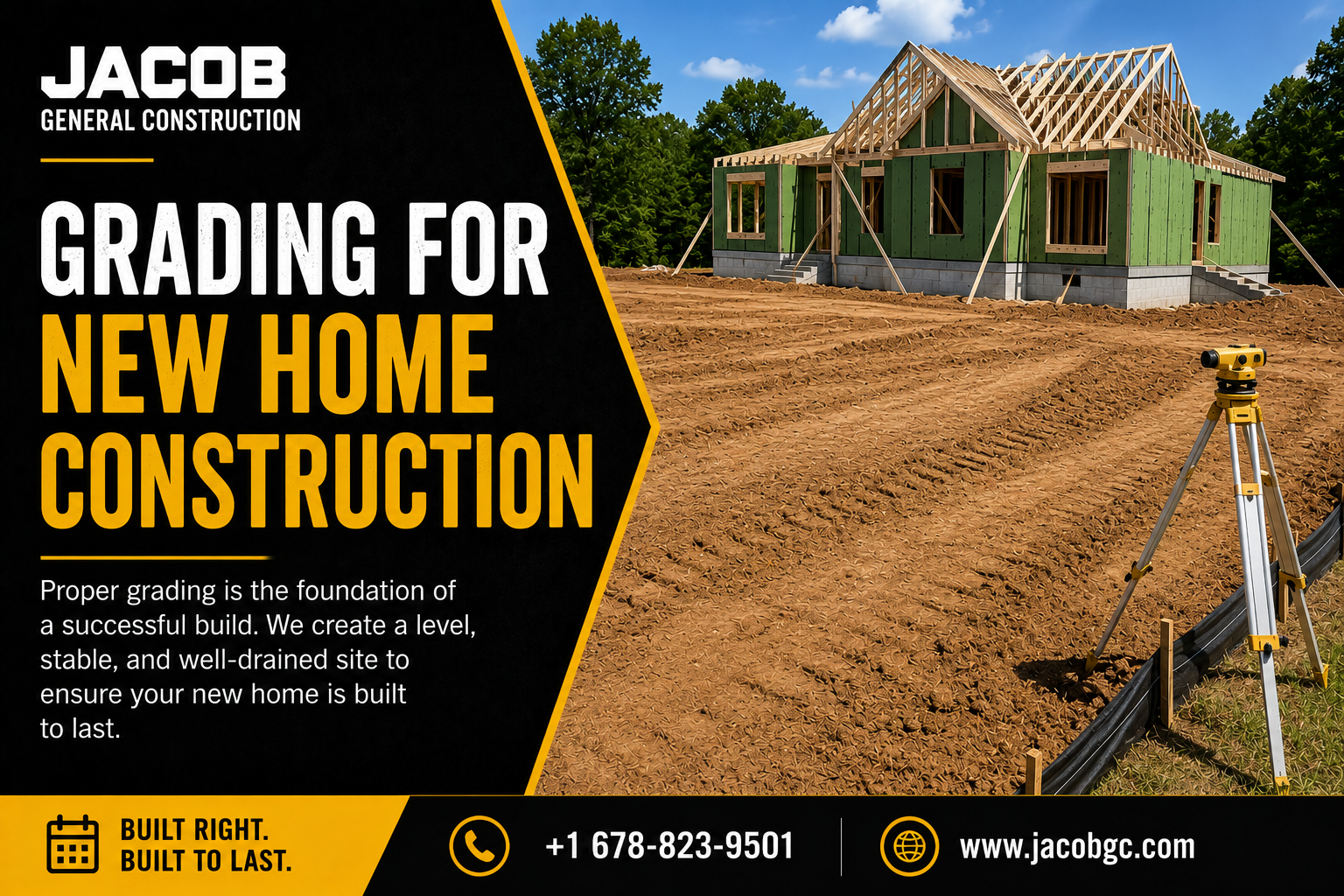
Grading Construction
Building a new home in Milton or Alpharetta is exciting, but before a single wall goes up, there’s a phase of the project that quietly determines how well that home will hold up for decades: grading. New grading construction home construction grading isn’t a single task — it’s a sequence of steps that shapes raw land into a stable, well-drained site ready for a foundation, driveway, and everything else that comes with it.
Homeowners and builders who understand what this grading construction process actually involves tend to end up with fewer surprises during construction and far fewer drainage or foundation problems after move-in. Here’s a full breakdown of how grading works for new home construction, why each phase matters, and what to expect if you’re planning a build in North Georgia.

Why Grading Comes Before Everything Else
Every other phase of home construction depends on what happens during grading. The foundation needs a stable, properly compacted pad. The driveway needs a base that won’t crack or shift. The septic system, if applicable, depends heavily on how water moves through the graded soil. Even landscaping and hardscaping later on are affected by how the site was originally shaped.
Skipping or rushing grading doesn’t save time in the long run — it just relocates problems to a more expensive and disruptive point later in the build, or worse, after the home is finished and occupied.
The Phases of Grading for New Construction
Phase 1: Land Clearing
Before grading construction equipment can shape the land, the site typically needs to be cleared of trees, brush, stumps, and debris. This is often the first visible sign of activity on a new construction lot. Land clearing needs to be done carefully to avoid unnecessary disruption to soil stability, especially on sloped lots common throughout Milton and Alpharetta.
Phase 2: Rough Grading
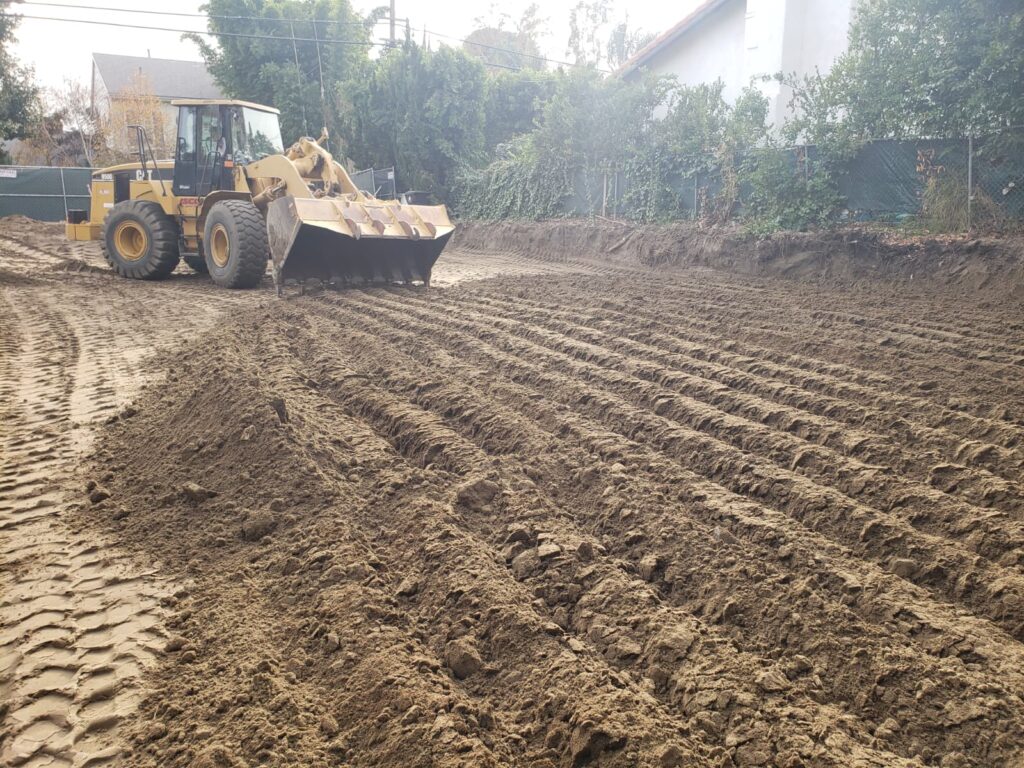
Once the site is cleared, rough grading establishes the general shape of the lot and the building pad. This includes:
- Cutting high areas and filling low areas to create a workable building surface
- Establishing the correct elevation for the building pad relative to the surrounding lot
- Creating initial drainage patterns that will guide where water flows during and after construction
- Compacting the building pad area so it can support the weight of the foundation
Rough grading needs to happen before the foundation is poured, since the foundation’s stability depends directly on how well this step is done.
Phase 3: Foundation and Construction
While the home is being built, the surrounding grading is typically left in a rough state, with erosion control measures in place to prevent runoff problems during construction. This is a period where proper drainage planning really pays off — an active construction site with exposed soil is especially vulnerable to erosion during Georgia’s heavy rain events.
Phase 4: Finish Grading
Once major construction is complete, finish grading shapes the final slope and surface of the property. This includes:
- Fine-tuning the slope immediately around the foundation to meet drainage standards
- Preparing the base for driveways, walkways, and patios
- Shaping the broader yard for landscaping, sod, or seeding
- Establishing final drainage paths toward swales, drains, or the street
Finish grading is what most homeowners actually see and interact with once the home is complete, but it only works well if the rough grading underneath it was done correctly.

The Foundation Drainage Standard
One of the most important benchmarks in new construction grading is the slope immediately surrounding the foundation. Standard guidance calls for a minimum drop of 6 inches over the first 10 feet away from the foundation — roughly a 5% grade. This slope is what reliably moves rainwater away from the home before it has a chance to saturate the soil against the foundation walls and create long-term moisture or structural problems.
This standard needs to be built into both the rough grading (establishing the pad elevation correctly) and the finish grading (fine-tuning the final slope) phases. Getting it right at both stages is what separates a home that stays dry for decades from one that develops moisture problems within the first few years.
Grading and North Georgia’s Terrain and Soil
Building in Milton or Alpharetta with jacob general construction means dealing with two specific site conditions that make grading especially important:
Rolling terrain. Many lots throughout this area aren’t flat, which means significant cut-and-fill work is often needed to establish a level, stable building pad. Sloped lots also require careful planning for how water will move around the finished home and toward the driveway.
Clay-heavy soil. North Georgia’s red clay soil drains more slowly than sandy soil and behaves differently when compacted. A grading plan that doesn’t account for this can result in a building pad or driveway base that holds water beneath the surface, leading to instability over time.
An experienced local grading contractor factors both of these conditions into every stage of the process, rather than applying a generic approach that might work fine in a different region but falls short here.
Coordinating Grading With Septic and Concrete Work
For many new home builds in North Georgia, especially in areas without municipal sewer access, septic system installation is part of the overall site work. Grading and septic design need to be closely coordinated, since the septic field’s performance depends directly on soil drainage and grading patterns. Water runoff from the building pad or driveway shouldn’t interfere with the septic field’s ability to absorb and treat wastewater properly.
Similarly, any concrete work — driveways, patios, garage slabs — needs a properly graded and compacted base underneath it. A contractor who handles grading, septic, and concrete together (rather than coordinating separately between multiple companies) tends to catch these interdependencies before they become expensive problems.
Common Grading Mistakes in New Construction
A few mistakes show up repeatedly in new construction grading, and they’re worth watching for whether you’re a homeowner overseeing a build or working with a general contractor:
- Building pad elevation set too low relative to the surrounding lot, creating a bowl effect that traps water near the home
- Insufficient compaction of the building pad, leading to settling issues after the home is built
- Finish grading rushed at the end of the project, without proper attention to the foundation slope standard
- Drainage not planned holistically, resulting in water simply being pushed to a different problem area rather than a proper drainage point
- Erosion control neglected during construction, leading to soil loss and drainage pattern changes before finish grading even begins
What to Ask Your Grading Contractor Before Construction Starts
If you’re building a new home, a few questions can help you gauge whether a grading contractor understands what your project actually needs:
- How will you set the building pad elevation relative to the rest of the lot?
- What slope standard will you use around the foundation?
- How will you handle erosion control during construction?
- How does the grading plan account for the driveway, septic field, and future landscaping?
- How does the local soil and terrain affect your approach to this specific lot?
A contractor who can answer these clearly and specifically — rather than giving generic answers — is more likely to deliver a site that performs well for years to come.
Build on a Site That’s Graded Right From the Start
Jacob General Construction has spent over 15 years handling grading for new home construction throughout Milton, Alpharetta, and the greater North Georgia area. We understand this region’s clay soil and rolling terrain, and we build every grading plan around long-term drainage performance, not just a site that looks ready on day one. If you’re planning new home construction, call us at 678-823-9501 for a free grading consultation.
The Critical Importance of Site Preparation in Residential Projects
Building a custom residential structure requires executing heavy earthmoving protocols to secure a stable and long-lasting foundation footprint. Homeowners frequently focus on floor plans while overlooking the structural value of professional Grading Construction on their lots. Choosing an experienced general contractor guarantees that your raw building pad stands fully optimized to withstand environmental changes.
Every single custom home project demands careful terrain adjustments to direct surface stormwater away from load-bearing walls. A masterfully executed plan for Grading Construction ensures that heavy cloudbursts cannot soften the underlying structural soil layers. Skipping this early site development phase relocates minor dirt issues to a much more expensive point after move-in.
Working with the established field crews at Jacob GC guarantees total compliance with strict regional engineering guidelines. Our team applies advanced heavy equipment methods to finalize a precise pad location that maximizes structural Grading Construction standards. Investing in specialized site stabilization protects your framing, masonry, and underground utility networks from early failure.
Preliminary Land Clearing and Technical Earthwork Sequences
Long-lasting structural stability depends completely on removing unstable organic matter before primary compaction machinery begins operation. Advanced site clearing and deep grubbing strip away ancient root networks, decaying logs, and soft topsoil layers cleanly. Rushing this early phase allows hidden organic material to decay, compromising the integrity of all subsequent Grading Construction steps.
North Georgia lots receive rapid clearing, industrial chipping, stump grinding, and technical subgrade preparation to establish a uniform foundation for your Grading Construction layout. Following clearing, heavy equipment operators shape rough building pads and balance cut-and-fill dirt volumes in accordance with engineering blueprints and compaction standards. Crews lay down crushed stone aggregate bases, install high-capacity French drains and trench networks, and manage underground utilities to protect septic tanks and municipal lines. Concrete slab foundations receive specialized moisture-curing protocols, followed by fine finish grading, slope verification, and code-compliant municipal permitting across regional jurisdictions. Detailed technical workflows, compaction indices, and subsurface protection matrices can be reviewed directly in the referenced source documents.
The Critical Importance of Site Preparation in Residential Projects
Building a custom residential structure requires executing heavy earthmoving protocols to secure a stable and long-lasting foundation footprint. Homeowners frequently focus on floor plans while overlooking the structural value of professional Grading Construction on their lots. Choosing an experienced general contractor guarantees that your raw building pad stands fully optimized to withstand environmental changes.
Every single custom home project demands careful terrain adjustments to direct surface stormwater away from load-bearing walls. A masterfully executed plan for Grading Construction ensures that heavy cloudbursts cannot soften the underlying structural soil layers. Skipping this early site development phase relocates minor dirt issues to a much more expensive point after move-in.
Working with the established field crews at Jacob GC guarantees total compliance with strict regional engineering guidelines. Our team applies advanced heavy equipment methods to finalize a precise pad location that maximizes structural Grading Construction standards. Investing in specialized site stabilization protects your framing, masonry, and underground utility networks from early failure.
Preliminary Land Clearing and Technical Earthwork Sequences
Long-lasting structural stability depends completely on removing unstable organic matter before primary compaction machinery begins operation. Advanced site clearing and deep grubbing strip away ancient root networks, decaying logs, and soft topsoil layers cleanly. Rushing this early phase allows hidden organic material to decay, compromising the integrity of all subsequent Grading Construction steps.
Land Clearing, Geology, and Compaction Essentials
Clearing dense vegetation and executing deep grubbing remove decaying roots and soft topsoil that threaten Grading Construction stability. Technicians deploy commercial machinery, chip onsite timber, and perform structural stump grinding to eliminate hidden subterranean decay zones.
North Georgia’s expansive red clay swells with moisture and requires engineered sub-bases of crushed stone aggregate to properly support Grading Construction requirements. Compaction using heavy vibratory rollers locks aggregate layers in place, preventing future settling beneath concrete or stone features.
Drainage, Utilities, and Regulatory Compliance
Engineered turf swales, French drains, and flow wells channel heavy seasonal stormwater safely away during Grading Construction. Crews carefully map municipal lines and protect private septic tank systems, maintaining safe buffer zones around 1000 to 2500 gallon tanks.
Navigating municipal regulations across Milton, Fulton, Cherokee, and Forsyth counties ensures your Grading Construction project avoids costly citations. Our bulk hauling fleet delivers structural materials and handles full site restorations or demolition to complete your build.
The Foundation of Successful Site Preparation
Building a new custom home requires executing heavy earthmoving protocols to secure a highly stable and long-lasting foundation footprint. Homeowners frequently focus on floor plans while completely overlooking the structural value of professional Grading Construction on their lots. Choosing an experienced general contractor guarantees that your raw building pad stands fully optimized to withstand environmental changes.
Every single custom home project demands careful terrain adjustments to direct surface stormwater away from load-bearing walls. A masterfully executed plan for Grading Construction ensures that heavy cloudbursts cannot soften the underlying structural soil layers. Skipping this early site development phase relocates minor dirt issues to a much more expensive point after move-in.
Working with the established field crews at Jacob GC guarantees total compliance with strict regional engineering guidelines. Our team applies advanced heavy equipment methods to finalize a precise pad location that maximizes structural Grading Construction standards. Investing in specialized site stabilization protects your framing, masonry, and underground utility networks from early failure.
Preliminary Land Clearing and Technical Earthwork Sequences
Long-lasting structural stability depends completely on removing unstable organic matter before primary compaction machinery begins operation. Advanced site clearing and deep grubbing strip away ancient root networks, decaying logs, and soft topsoil layers cleanly. Rushing this early phase allows hidden organic material to decay, compromising the integrity of all subsequent Grading Construction steps.
If your North Georgia lot features dense vegetation, our operators deploy heavy-duty logging machinery for rapid timber extraction. We manage expert land clearing, operating a high-capacity industrial wood chipper for efficient onsite chipping and Grading Construction layout preparations. Our comprehensive site preparation services also include precision grinding, tree mulching, and strategic tree felling before earthmoving shifts begin.
Property owners depend heavily on our mechanical fleet for technical tree trimming and complete tree removal across the footprint. Any buried logs or fallen trees are extracted systematically to ensure maximum subsurface density for your Grading Construction footprint. We jacob general construction performs structural stump grinding and total stump removal to prevent hidden subterranean decay zones from compromising home stability.
Frequently Asked Questions
1. When during construction does grading happen?
Grading happens in phases: rough grading after land clearing (to establish the building pad), and finish grading near the end of construction (to shape the final yard, driveway base, and landscaping areas).
2. How much does grading cost for a new home build?
Costs vary significantly based on lot size, existing terrain, how much cut-and-fill work is needed, and soil conditions. A sloped or heavily wooded lot generally costs more to grade than a relatively level, cleared one. We provide free, detailed estimates after evaluating the site.
3. Does new construction grading affect where I can put a septic system?
Yes. Septic field performance depends on proper soil drainage and grading. Grading is typically coordinated with septic design so runoff from the building pad doesn’t interfere with the drain field’s function.
4. What happens if grading isn’t done correctly during new construction?
Problems can range from water pooling near the foundation and basement or crawl space moisture, to a driveway that cracks and settles prematurely, to erosion damage across the property. These issues are far more expensive to fix after the home is built than during initial site work.
5. How does clay soil in Milton and Alpharetta affect new construction grading?
Clay soil drains slowly and compacts differently than sandy soil, which means grading plans need to account for how it behaves when saturated versus dry. An experienced local contractor builds this into the plan from the start.
6. Can grading be done in phases during a long construction project?
Yes, and it typically is. Rough grading happens early to prepare the building pad, while finish grading happens near the end once major construction and other site work are complete.
7. Do I need a separate grading contractor, or can my homebuilder handle it?
Some homebuilders subcontract grading to a specialized contractor, while others handle it in-house. Either way, it’s worth confirming the contractor doing the grading has specific experience with local soil and terrain conditions.
8. How long does grading take for a typical new home construction project?
Rough grading for a residential lot often takes several days to a couple of weeks depending on lot size and terrain, with finish grading happening later in the project timeline. We provide a clear schedule as part of every estimate.
Core Aggregates, Engineered Drainage, and Site Compaction
The longevity of a slab on grade foundation depends entirely on the stabilization of the hidden stone layers beneath it. Pouring concrete directly onto loose earth or shifting clay guarantees failure, which is why smart Grading Construction requires base engineering. We jacob general construction build a dense platform using coarse #57 stone, crusher run, and pea gravel to distribute vehicular loads evenly.
Every aggregate layer undergoes deep compaction and rolling to lock in stone integrity for your Grading Construction layout. We manage utility coordination, septic field protection, and complete local compliance across Fulton, Cherokee, and Forsyth county jurisdictions.
Explore our complete range of structural, paving, and site preparation solutions by visiting our Our Services page. You can also review official transportation and construction-related guidelines through the Georgia Department of Transportation (GDOT) website.
Article Comments (0)