

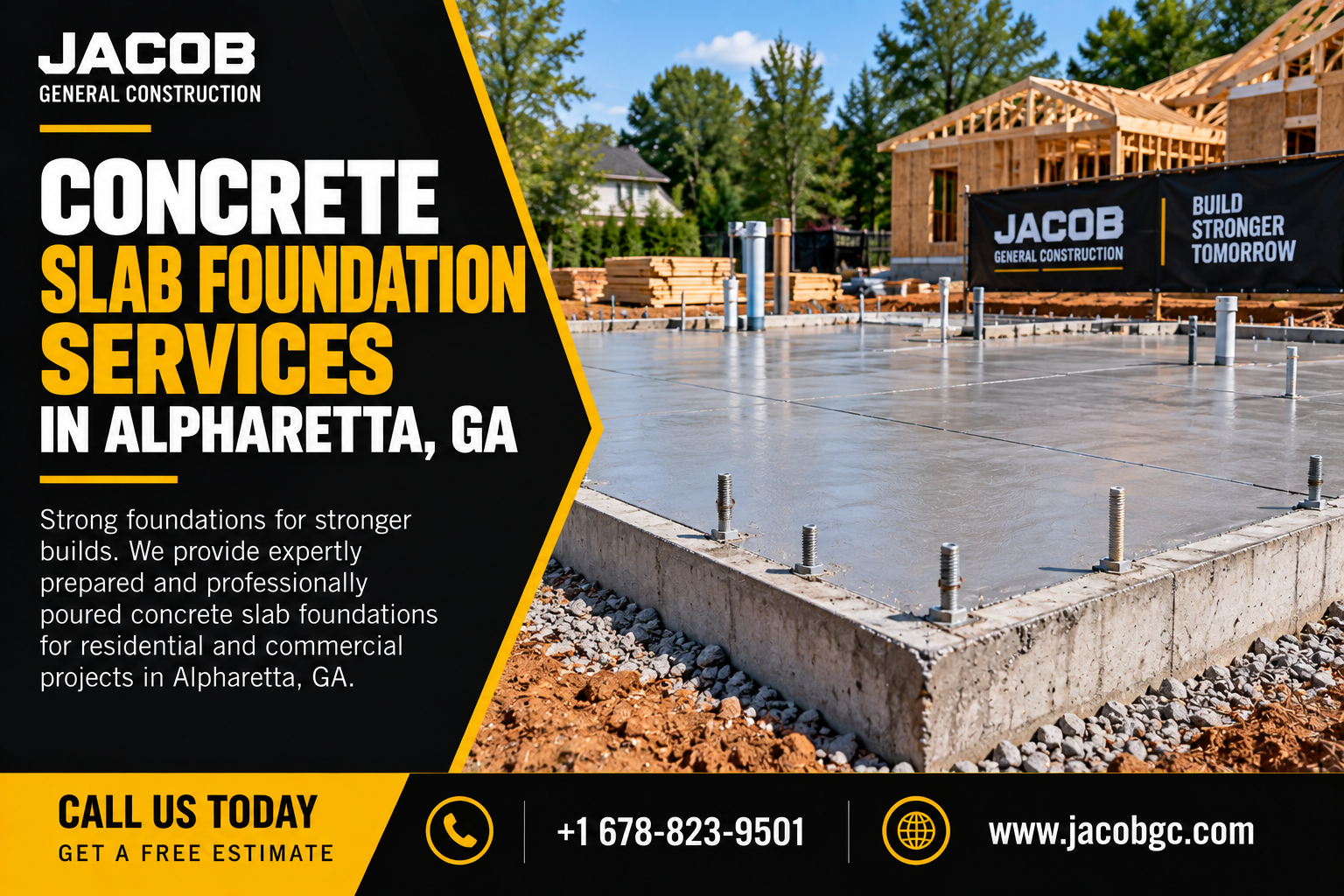
Concrete Slab Services In Alpharetta GA ensure that your new build stays solid, because every structure is only as stable as what it sits on. A properly constructed concrete slab foundation is one of the most common and reliable methods for supporting home additions, garages, workshops, or outbuildings. It provides a flat, durable base that can last for decades. Conversely, when foundation work is substandard, problems quickly manifest in the walls, floors, and doors above it.
This guide explains how slab foundations work, what proper preparation looks like on an Alpharetta property, and what to consider before your project begins. For more on the work we do, see our concrete service in Alpharetta, GA.
What Is a Slab Foundation?
A slab foundation, often called a slab-on-grade, is a layer of reinforced concrete poured directly onto prepared ground. Instead of raising the structure over a crawl space or basement, the slab itself serves as both the foundation and the floor. The edges are typically thicker than the center to provide added strength where the walls will bear weight.
Slabs are popular because they can be built efficiently, they provide a solid, level surface, and they suit a wide range of projects when the ground is prepared correctly.
Where Slab Foundations Are Used
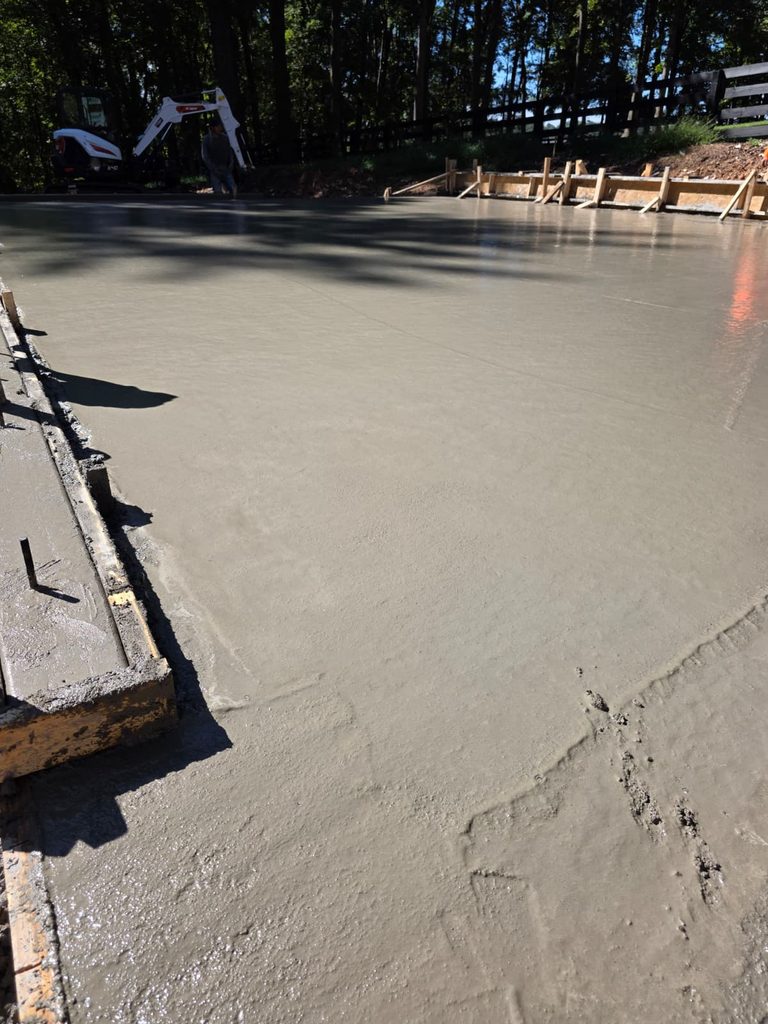
In and around Alpharetta, slab foundations are commonly used for:
- New home construction
- Home additions and room extensions
- Attached and detached garages
- Workshops, sheds, and other outbuildings
- Commercial pads and small commercial structures
The design of the slab depends on what it will support, so a garage slab and a slab beneath a heated living space are not necessarily built the same way.
Why Site Preparation Comes First
Most slab problems trace back to the ground rather than the concrete. Before any forms are set, the site should be cleared, graded, and compacted. Topsoil and organic material are removed because they decompose and settle. Any fill that has been added needs to be compacted properly, since loose fill is a common cause of uneven settling.
Soil matters here in north Georgia. Clay-heavy soils hold moisture and can behave differently from sandy soils, which is why a slab should be designed and prepared for the conditions on your specific lot. Drainage is part of the same conversation. Water should be directed away from the slab so it does not soften the ground supporting it.
Key Components of a Slab Foundation
A properly built slab is a system, not just a pour of concrete. Typical components include:
- Thickened edges or footings: extra depth and strength around the perimeter and under load-bearing walls.
- Compacted base: a layer of compacted stone that gives the slab stable, well-draining support.
- Moisture barrier: a sheet placed beneath the slab in many designs to limit moisture moving up through the concrete.
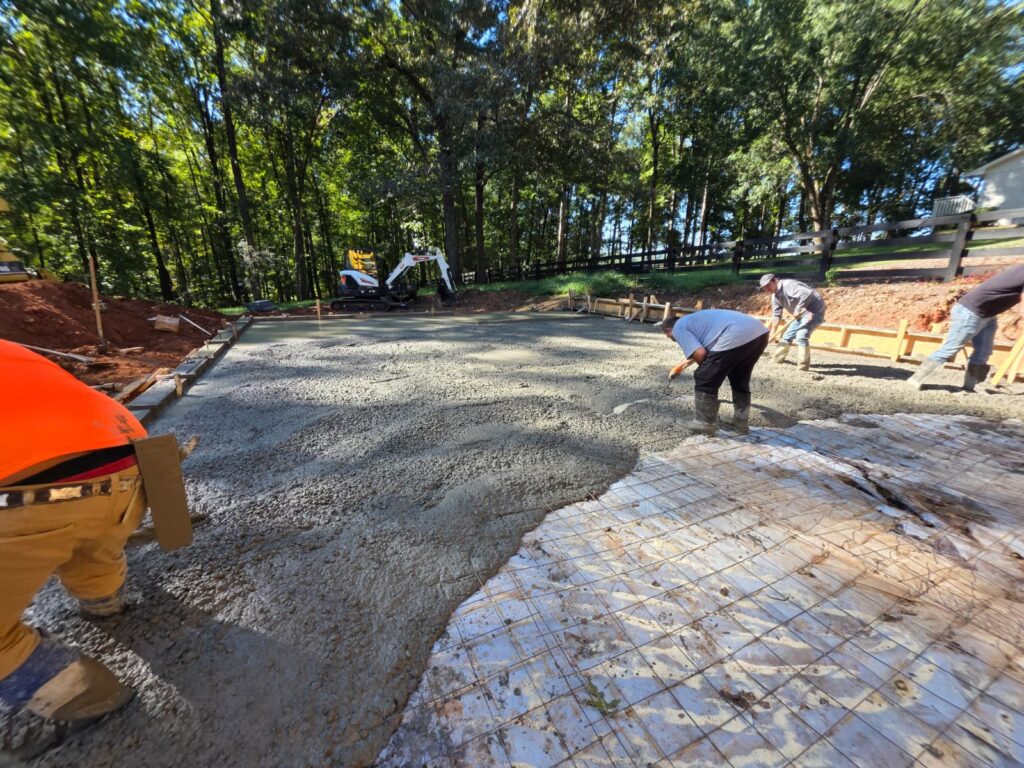
- Reinforcement: steel rebar or wire mesh that helps the slab resist cracking and carry loads.
- Utility rough-ins: plumbing or electrical lines that must be set in place before the concrete goes in.
Getting these pieces coordinated before the pour is important, because changes afterward are difficult and expensive.
The Pouring and Finishing Process
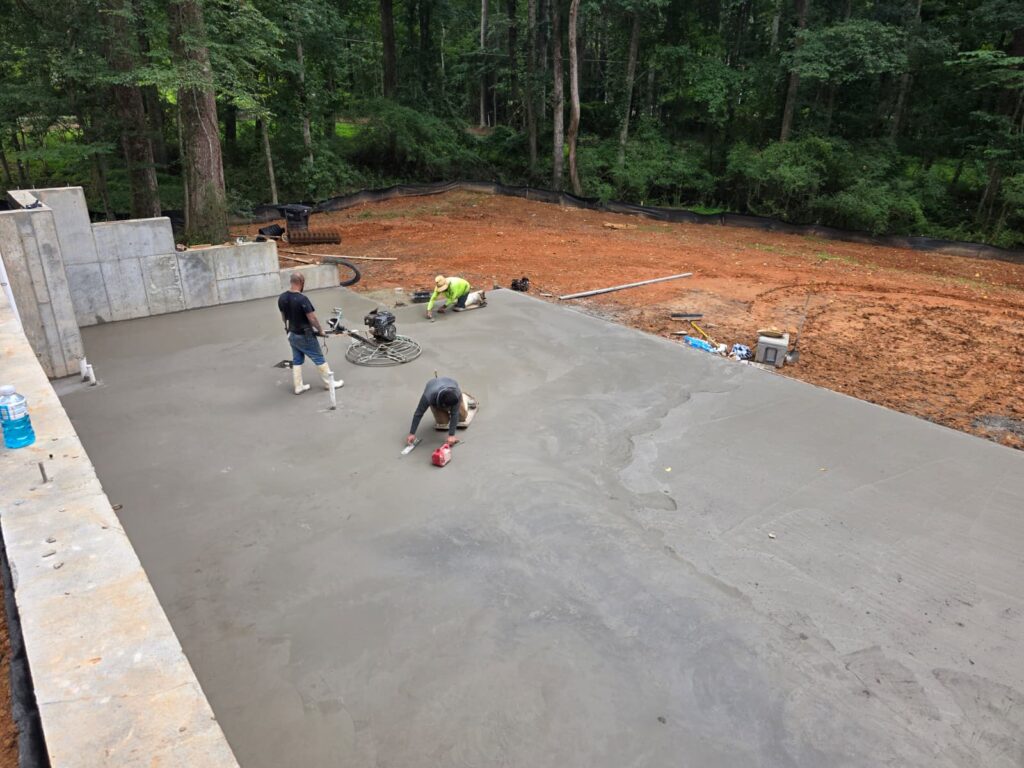
Once the base, forms, and reinforcement are ready, the concrete is placed and spread evenly. It is leveled, floated, and finished to the surface required for the project, whether that is a smooth interior floor or a broom-textured garage slab. Control joints are added so that shrinkage cracking, which is normal to some degree, happens along planned lines.
Timing and weather influence the results. Concrete that dries too fast in heat or wind can develop surface cracks, so crews adjust placement, finishing, and curing methods to the day’s conditions.
Curing: Why Patience Matters
Concrete gains strength gradually. It may be strong enough to walk on within a few days, but reaching full strength takes about 28 days. During that time, the slab should be protected from rapid drying and from heavy loads. Rushing construction onto a slab before it has cured adequately can lead to avoidable damage. Follow the guidance of your contractor and your builder on when framing and heavy work can begin.
Design, Permits, and Inspections
Foundations for structures are different from a simple patio or walkway. They generally involve a design that suits the building and the soil, along with permits and inspections. Alpharetta has land-development and stormwater requirements that may apply depending on the scope and location of the project, so confirm the applicable requirements with the city before work begins. If your slab supports a new home or addition, your builder, architect, or engineer will typically specify the design requirements the concrete work needs to meet.
Common Slab Problems and What Causes Them
Knowing the warning signs helps you catch problems early:
- Wide or growing cracks: often linked to poor base preparation, inadequate reinforcement, or ground movement.
- Uneven or sunken areas: commonly caused by poorly compacted fill or water washing out the soil beneath.
- Moisture coming through the floor: may indicate missing or damaged moisture protection or drainage problems around the structure.
- Doors and windows that stick: can signal foundation movement.
If you notice any of these on an existing slab, have the cause evaluated before repairs are made. Fixing the symptom without addressing the cause usually means the problem returns.
Choosing a Concrete Slab Contractor
Ask any contractor how they prepare and compact the base, how they handle drainage, what reinforcement they use, and how they coordinate with plumbing and other trades. Ask for a clear scope and timeline. Foundation work is not the place to choose on price alone, because errors are hard to correct once the structure is built on top. Also confirm who is responsible for coordinating inspections and how the contractor communicates schedule changes, since foundation work often depends on other trades arriving on time.
Build on a Solid Foundation
A slab foundation should give you decades of stable support, and that starts with proper preparation and careful pouring. Jacob General Construction pours foundations and slabs for new construction, additions, garages, and outbuildings, working from properly prepared and compacted ground. Learn more about our concrete service in Alpharetta, GA, or call 678-823-9501 to discuss your project.
Frequently Asked Questions
How thick is a concrete slab foundation?
Many residential slabs are around four inches thick in the main area, with thicker edges or footings where walls and loads are concentrated. The exact design depends on the structure, soil, and requirements for your project.
How long does it take to pour and cure a slab?
Pouring a typical residential slab is often completed in a day once the site, forms, and reinforcement are ready. Curing takes longer, with full strength developing over about 28 days.
Can I build a home addition on a concrete slab?
Yes, slab foundations are commonly used for additions. The new slab needs to be designed and prepared so it works properly with the existing structure and drainage on your property.
Are small cracks in a slab normal?
Minor hairline cracks are common as concrete cures and shrinks. Cracks that widen, or areas that sink or become uneven, should be evaluated to find the underlying cause.
Do I need a permit for a slab foundation in Alpharetta?
Foundations for structures generally require permits and inspections. Confirm the requirements for your project with the city before work begins.
Advanced Structural Engineering for Concrete Slab Services in Alpharetta GA
The long-term performance of a monolithic or slab-on-grade foundation depends entirely on regional structural engineering principles. In north Georgia, residential and commercial projects require a deep understanding of local environmental factors.
When hiring professional concrete slab services in alpharetta ga, the process begins with evaluating the structural loads the slab will bear. A standard residential slab differs fundamentally from an industrial warehouse floor or heavy machinery pad.
Architects and engineering teams calculate dead loads, which represent the permanent weight of the building materials, alongside live loads, which encompass the transient weight of occupants, furniture, vehicles, and equipment. Securing experienced concrete slab services in alpharetta ga ensures that these calculations are precise.
Beyond weight, structural design dictates the exact layout of internal reinforcement mechanisms. In our region, temperature variations throughout the seasons create internal stress within the curing mass.
As a result, engineers providing concrete slab services in alpharetta ga often integrate specialized structural components, such as post-tensioned cables or targeted steel reinforcement grids, to offset high tensile stress.
Monolithic slabs are particularly popular in Alpharetta because they combine the foundation footing and the primary subfloor into a single, uniform concrete pour. This structural unity eliminates cold joints—the weak points created when separate layers of concrete are poured at different times—resulting in a highly stable structural footprint that reputable concrete slab services in alpharetta ga always recommend.
Furthermore, local regulations mandate strict compliance with the International Residential Code (IRC) and local zoning modifications.
These legal frameworks outline exactly how deep footings must extend to surpass the regional frost line, ensuring that cold winter snaps do not trigger frost heaves beneath your home addition or commercial expansion.
Choosing specialized engineering and pouring teams who specialize in concrete slab services in alpharetta ga guarantees that these technical specifications transition accurately from blueprint calculations to physical reality on your job site.
Subsurface Mechanics and Georgia Red Clay Challenges
To understand why professional execution matters, one must examine the distinct subsurface geology of north Georgia. The widespread presence of Georgia red clay presents distinct engineering challenges that standard building practices cannot address. Clay soils are classified as expansive, meaning they expand significantly when saturated with water and shrink during periods of high heat and drought.
This constant cycle of swelling and shrinking applies continuous hydrostatic and structural pressure to any foundation poured directly over it, making standard work highly risky without premium concrete slab services in alpharetta ga.
Professional concrete slab services in alpharetta ga focus heavily on altering and stabilizing this native soil before bringing concrete delivery trucks to the site. If a crew pours a heavy concrete mixture directly onto unconditioned clay, the foundation will shift within a few seasons.
The soil beneath will absorb seasonal rain, swell upward against the middle of the slab, and then pull away during the summer, leaving hollow voids beneath the heavy structural corners. To prevent this, expert contractors delivering concrete slab services in alpharetta ga excavate a significant portion of the native clay, replacing it with an engineered sub-base consisting of graded, crushed granite aggregate. This coarse stone layer acts as a mechanical buffer, distributing structural weight evenly while preventing the expansive clay from applying direct upward pressure to the concrete.
Additionally, sub-base preparation requires mechanical compaction using heavy vibratory rollers, which is a standard procedure for top-tier concrete slab services in alpharetta ga. Compaction eliminates air pockets and tightly locks the aggregate particles together, creating a high-density platform that minimizes future structural settling. Trusting these steps to established concrete slab services in alpharetta ga saves thousands of dollars in potential foundation repairs down the road.
Advanced Moisture Mitigation Strategies
Managing underground water vapor is essential for any interior living space or climate-controlled commercial building. Concrete appears solid to the naked eye, but it is actually a highly porous, sponge-like material containing millions of microscopic capillaries. Ground moisture constantly moves upward through the soil via capillary action, migrating through the slab toward the dry air of your home’s interior. Without proper protection handled by specialized concrete slab services in alpharetta ga, this vapor transmission destroys hardwood flooring, causes luxury vinyl tile adhesives to fail, and promotes mold growth under carpets.
Modern Concrete Slab Services In Alpharetta GA
Modern concrete slab services in alpharetta ga incorporate multi-layered moisture vapor mitigation systems to address this problem. The standard defense is a heavy-duty, puncture-resistant polyethylene vapor retarder, which must be at least 10 to 15 mils thick to withstand construction foot traffic without tearing. This barrier is laid directly over the compacted stone base before the steel reinforcement is set, a critical process that experienced concrete slab services in alpharetta ga execute with extreme care.
Contractors must overlap all seams by a minimum of six inches and seal them tightly with specialized waterproofing tape. Any penetrations, such as sewer lines, electrical conduits, or water pipes, are wrapped and sealed to form an airtight barrier against underground moisture. When utilizing comprehensive concrete slab services in alpharetta ga, every detail of this vapor barrier is verified before the pour. In premium commercial applications, low-permeance barriers are paired with specialized sub-slab drainage networks that channel liquid water safely away to low points on the property before it can reach the vapor barrier.
The Financial and Structural Return on Investment of Quality Foundations
Investing in premium foundation installation provides significant long-term financial returns for both residential and commercial property owners. The foundation is the most critical element of any building; every structural component above it relies on its stability. If a foundation is poorly executed to save on upfront costs, the long-term expenses for structural remediation can easily quadruple the initial investment.
By hiring experienced concrete slab services in alpharetta ga, you protect your property against foundation settling, shifting walls, and water damage. A high-quality slab keeps structural framing perfectly square, preventing drywall cracks, misaligned roof lines, and sticking windows or doors. Navigating these regional soil variables requires the precision that only certified concrete slab services in alpharetta ga can provide.
Additionally, homes built on professionally engineered slabs hold higher real estate valuation scores, as home inspectors and structural engineers can verify the quality of the underpinning work. Securing top-tier concrete slab services in alpharetta ga minimizes long-term maintenance costs, reduces insurance premiums, and gives you total peace of mind knowing the core of your investment is secure.
Designing Specialized Slabs for Commercial Applications in concrete slab services in alpharetta ga
Commercial slabs must meet much higher durability standards than standard residential foundations. Industrial settings, retail centers, and commercial storage hubs require thick slab designs capable of supporting extreme point loads from heavy racking systems, forklifts, and large commercial vehicles.
When managing commercial projects, premier concrete slab services in alpharetta ga follow a rigorous engineering protocol to ensure long-term durability. These commercial slabs are often specified at thicknesses ranging from 6 to 12 inches or more, utilizing high-performance 4,000 to 5,000 PSI concrete mixes tailored for wear resistance. Engineering these deep-profile surfaces demands specialized heavy-duty tools owned by leading concrete slab services in alpharetta ga.
Commercial projects also require precise control joint layouts to prevent uncontrolled cracking caused by thermal expansion and industrial machinery vibrations. Contractors use advanced dustless early-entry saws to cut these control joints within hours of finishing, ensuring the concrete relieves its internal stress exactly where planned.
Furthermore, commercial slab design often incorporates specialized surface hardeners and liquid densifiers. These chemical additives react with the free lime in the concrete to create a highly dense surface layer, protecting the slab from chemical spills, oil penetration, and the constant abrasion of heavy warehouse traffic—standards that top concrete slab services in alpharetta ga routinely deliver.
Environmental Controls and Seasonal Pouring Logistics
The changing climate of north Georgia requires strict operational adjustments throughout the year. Pouring concrete in the middle of a hot, humid July requires a completely different approach than working during a cold January morning. Professional teams providing concrete slab services in alpharetta ga adapt their mixing, placement, and finishing techniques to match these seasonal changes perfectly.
During summer, high temperatures and low humidity accelerate the setting time of wet concrete, creating a challenge known as hot-weather placement. To prevent the mix from setting too quickly inside the delivery trucks, concrete slab services in alpharetta ga add specialized chemical retarders to the batch mix. These additives slow the initial chemical reaction, giving finishing crews enough time to place, level, and float the surface accurately. Teams may also pour early in the morning to avoid the intense afternoon heat.
Conversely, winter pours present freezing risks; if the water inside un-hydrated concrete freezes, it expands and permanently ruins the internal crystalline structure. During cold weather, contractors handling concrete slab services in alpharetta ga use heated mixing water, accelerating admixtures, and insulated thermal blankets to maintain ideal curing temperatures above 50°F, ensuring the slab develops full structural strength regardless of the weather outside.
Advanced Drainage and Termite Protection Systems
A comprehensive slab installation must account for environmental factors beyond the concrete itself, specifically water management and pest prevention. Because slab-on-grade foundations sit close to the surrounding ground level, they are uniquely vulnerable to surface water runoff and wood-boring insects like termites, which thrive in the warm, moist climate of north Georgia.
When preparing a site for high-performance concrete slab services in alpharetta ga, contractors coordinate closely with grading teams to establish a positive slope away from the foundation perimeter. This slope ensures that heavy rainfall drains away from the building rather than pooling against the concrete edge, preventing the underlying soil from softening.
Additionally, before the moisture barrier is laid down, the subgrade soil receives a specialized liquid termiticide treatment. This chemical barrier creates an invisible shield beneath the slab, preventing termites from tunneling through minor soil gaps to reach the wooden framing above. For maximum protection, modern installations managed by professional concrete slab services in alpharetta ga also feature physical flashing barriers along the exterior sill plates, blocking pests and water from entering the home’s structure.
Seamless Trades Coordination: Plumbing and Electrical Prep
One of the most challenging aspects of pouring a slab foundation is that once the concrete cures, all under-slab utility lines are permanently locked in place. Any errors made during the rough-in phase of plumbing, electrical conduits, or gas lines require breaking up the new concrete with jackhammers to fix, causing costly project delays. Choosing a complete package for concrete slab services in alpharetta ga guarantees that trade coordination runs seamlessly, keeping your timeline and budget perfectly intact.
Explore our complete range of structural, paving, and site preparation solutions by visiting our Our Services page. You can also review official transportation and construction-related guidelines through the Georgia Department of Transportation (GDOT) website.
Article Comments (0)