

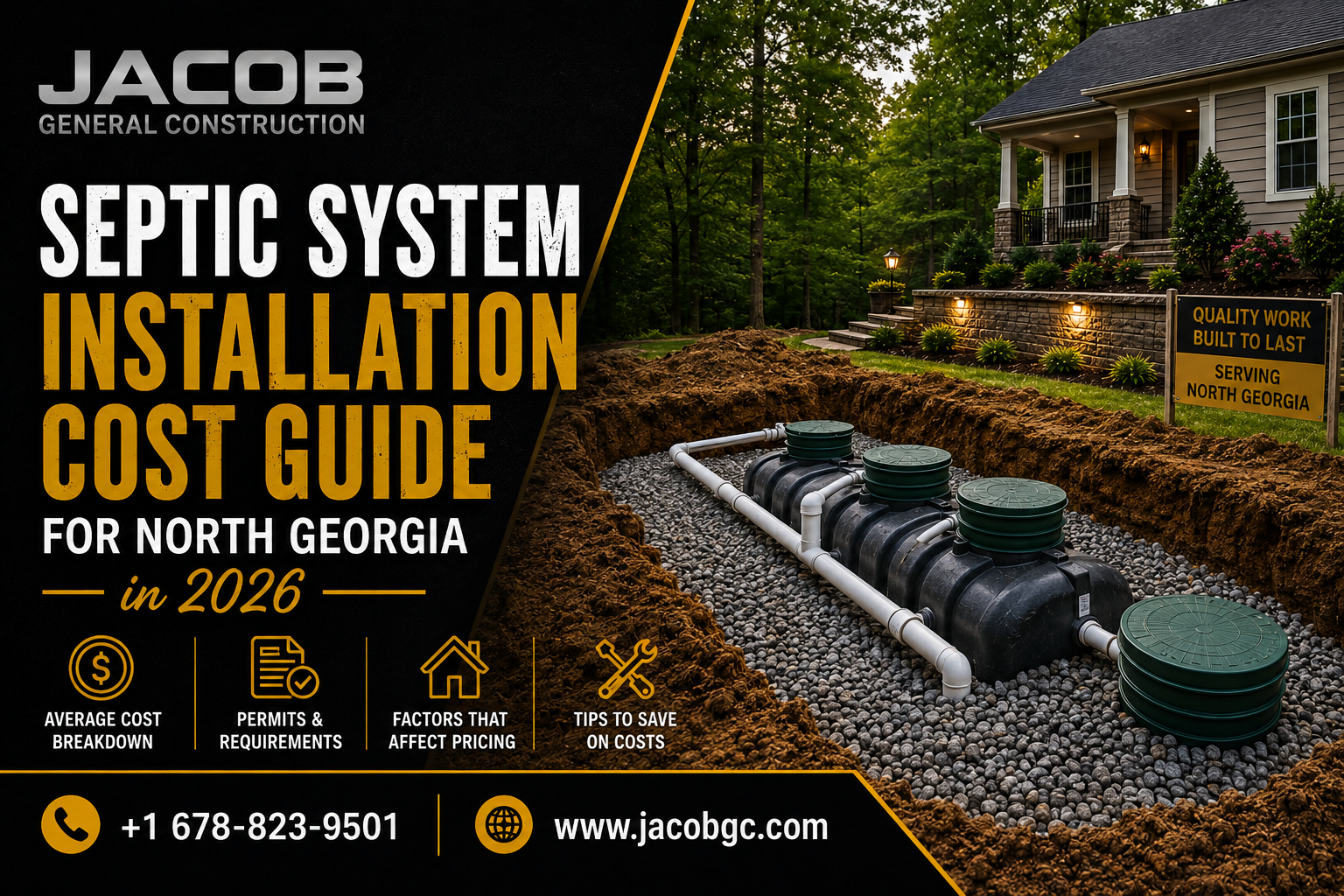
One of the first questions we hear from North Georgia homeowners planning a new build or a septic replacement is simple: “What’s this going to cost me?” The honest answer is that septic costs vary more than almost any other part of home construction, because they depend entirely on what your specific soil can — and can’t — support. Here’s a real breakdown of what drives the price, so you know what to expect before you get a quote.
Why Septic Costs Vary So Much
Unlike a concrete driveway, where pricing is fairly predictable per square foot, septic system costs depend on your lot’s soil, slope, size, and household needs. Two homes on the same street can have completely different septic costs if one sits on soil that supports a conventional system and the other requires an engineered one.
The factors that matter most:
- Soil type and perc test results — the single biggest cost driver in North Georgia, where clay soil frequently requires an engineered system instead of a standard one
- System type — conventional gravity system, versus an engineered mound or drip system
- Household size — determines tank size and drain field capacity requirements
- Lot size and slope — steeper or smaller lots can limit design options and add installation complexity
- Site accessibility — how easy it is to get equipment to the installation area
- Permitting and inspection fees — set by your county Environmental Health Department
General Cost Ranges
These are general planning ranges for North Georgia. Your actual cost depends on your specific soil evaluation and site conditions — treat these as a starting point for budgeting, not a quote.
Conventional Septic System
A standard gravity-fed system, on soil that passes a conventional perc test, is typically the most affordable option. This works well on lots with decent drainage and adequate space for a standard drain field.
Engineered Systems (Mound or Drip)
Because North Georgia’s clay soil often can’t support a conventional system, a significant share of homeowners here need an engineered design. These systems cost more due to imported materials (sand, for a mound system), pump equipment, and more complex design and installation. Expect engineered systems to run notably higher than a conventional system — the exact premium depends on your specific soil and site conditions.
Septic Tank Replacement Only
If your drain field is still functioning and only the tank needs replacement, this is a smaller project than a full system install — but cost still varies with tank size, access to the site, and whether the old tank needs to be removed or can be abandoned in place per county rules.
Drain Field Replacement Only
If your tank is fine but your drain field has failed, replacement cost depends heavily on whether the new field can go in the same footprint, or whether soil conditions require relocating it, or an entirely different system type.
What’s Usually Included in a Septic Installation Quote
- Site evaluation and coordination with soil testing
- System design (or coordination with a licensed designer for engineered systems)
- Permitting with your county Environmental Health Department
- Excavation and installation of tank and drain field
- Backfill and site restoration
- Final inspection coordination
What Can Add to the Cost
- Difficult site access — heavily wooded lots, steep driveways, or tight urban lots can require smaller equipment and more labor hours
- Rock encountered during excavation — common in parts of North Georgia and can require additional equipment
- Engineered system upgrades — a mound or drip system costs more than conventional in both materials and design
- Larger household size — more bedrooms/bathrooms typically means a larger tank and drain field are required by code
- Existing system removal — demolishing and properly disposing of a failed old system before installing a new one
How to Get an Accurate Number for Your Property
Because so much depends on your specific lot, the only way to get a real number is a site visit and (if you haven’t already had one) a perc test. Any quote given without a soil evaluation is a rough estimate at best. If you’re comparing quotes from different contractors, make sure each one is based on the same soil data and the same system type — otherwise you’re not really comparing apples to apples.
Questions worth asking any contractor before you commit:
- Has a perc test been done on my property, and does your quote reflect the actual results?
- Is this quote for a conventional or engineered system?
- What size tank and drain field is being quoted, based on my household size?
- Are permitting and inspection fees included, or separate?
- What’s your timeline, and does it account for county permit approval time?
Budgeting for New Construction
If you’re planning a new home, it’s worth getting your septic site evaluation done early — before your house plans are finalized. On clay-heavy North Georgia lots, the septic design can influence where your house sits, how much usable yard you have, and your overall site budget. Waiting until plans are locked in can mean expensive redesigns if the soil doesn’t support what you originally planned.
Frequently Asked Questions
What’s the cheapest type of septic system to install? A conventional gravity-fed system, on soil that passes a standard perc test, is generally the most affordable option. Whether your lot qualifies for one depends entirely on your soil evaluation results.
Does homeowners insurance cover septic system replacement? Typically, no. Standard homeowners insurance usually doesn’t cover septic system failure due to age, wear, or lack of maintenance. Some policies may cover damage from a sudden, specific covered event — check your individual policy for details.
Are there financing options for septic installation? Many septic contractors offer financing options, and some counties or state programs offer assistance for septic repairs in certain circumstances. Ask your contractor directly about available financing when you request your estimate.
Why do two contractors give me such different septic quotes? Quotes can vary significantly if they’re based on different assumptions — different system types, different tank sizes, or one contractor working from an actual soil evaluation while another is estimating without one. Always confirm what each quote is actually based on before comparing.
Is septic installation included when I buy vacant land, or is it a separate cost? It’s a separate cost. Raw land typically doesn’t include a septic system, so you’ll need to budget for soil evaluation, design, permitting, and installation as part of your overall build cost.
Get a Real Number, Not a Guess
At Jacob General Construction, we provide clear, itemized estimates based on an actual site evaluation of your North Georgia property — not a generic ballpark. Whether you’re installing a new system, replacing a failed drain field, or just want to know what to budget for before you buy land, we’ll walk the property with you and give you real numbers.
Ready to find out what your septic project will actually cost? Contact Jacob General Construction for a free, on-site estimate.
Article Comments (0)