

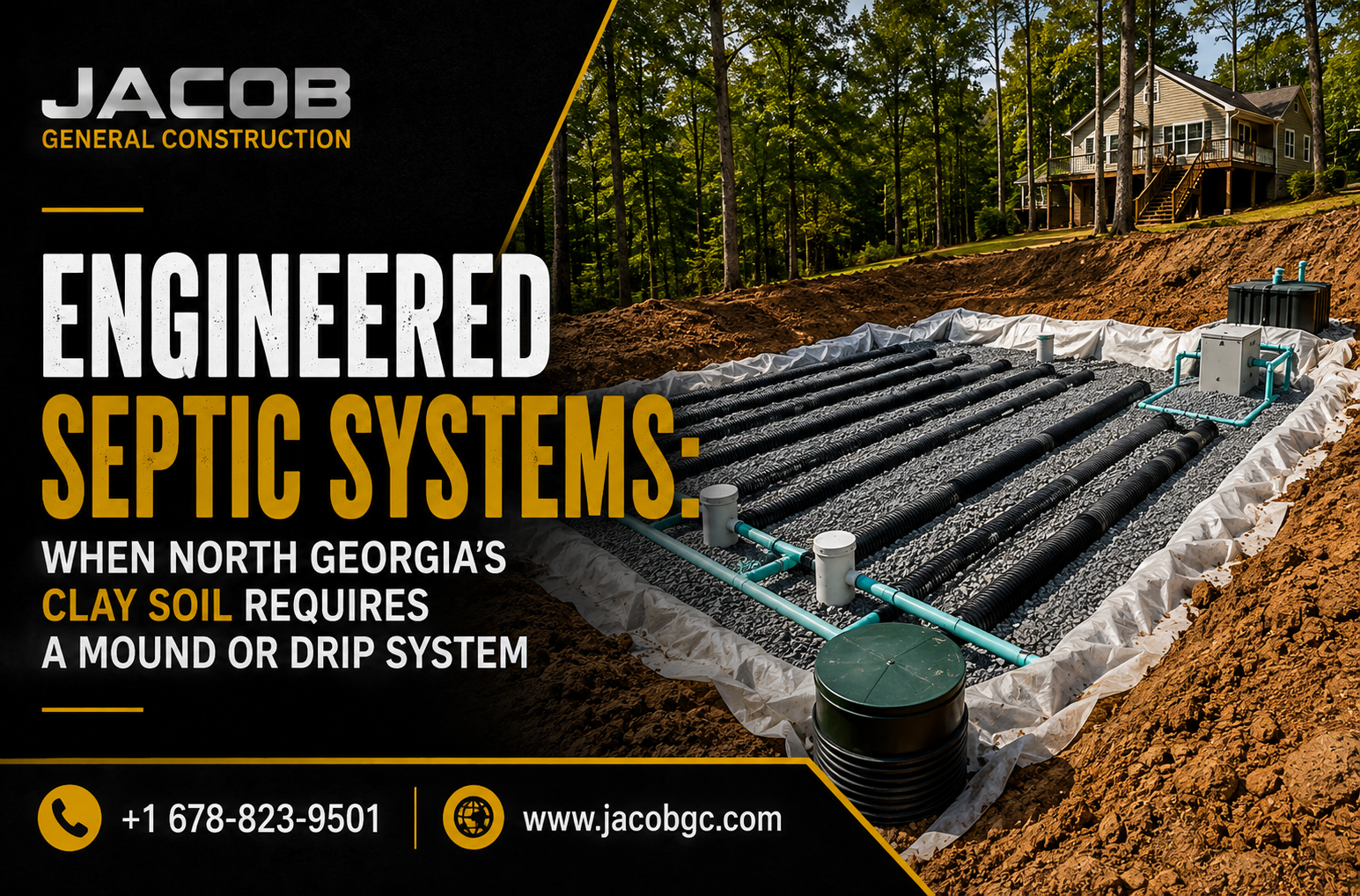
Not every lot in North Georgia can support a standard septic system — and that’s not a problem with the property, it’s just a reality of building on the region’s dense clay soil. If your perc test comes back showing slow drainage, don’t panic. It doesn’t mean you can’t build. It means you need an engineered system, and North Georgia contractors install these regularly.
Here’s what an engineered septic system actually is, when you need one, and how the two most common types — mound and drip systems — compare.
Why Some North Georgia Lots Need an Engineered System
A conventional gravity-fed septic system relies on soil absorbing effluent at a reasonable rate. Georgia’s Piedmont clay, common throughout Forsyth, Cherokee, and the greater North Georgia area, often doesn’t drain fast enough to support that design safely. Add in shallow bedrock, steep or hilly terrain, and a high water table in some low-lying areas, and a meaningful share of North Georgia lots simply need something more than a standard system.
The good news: engineered systems are a proven, code-approved solution, not a workaround. Your county Environmental Health Department reviews and permits these systems just like conventional ones, based on your soil evaluation and a design from a licensed engineer or installer.
Mound Systems
A mound system builds the drain field above the natural ground level, inside a constructed mound of sand and specially selected fill soil. Effluent from the septic tank is pumped into the mound, where it filters down through the engineered sand layer before reaching the natural soil beneath.
Why it works on clay soil: Instead of relying on native clay to absorb wastewater, the mound provides a properly draining medium built specifically for that purpose. The native soil only has to accept the smaller amount of water that’s already been filtered through the sand.
Best suited for: – Lots with slow-draining clay soil – Properties with a shallow water table or bedrock close to the surface – Lots with adequate space and appropriate slope for the mound’s footprint
Trade-offs: – Requires more land area than a conventional system – The visible mound changes the landscape (though it can be planted with grass and blended into yard design) – Higher installation cost than a conventional system, due to imported sand and a pump system
Drip Distribution Systems
A drip system uses a network of small-diameter tubing, laid in shallow trenches just below the surface, to distribute effluent slowly and evenly across a larger area. A pump and timer control small, precisely dosed releases, allowing the soil to absorb wastewater gradually rather than all at once.
Why it works on clay soil: Because drip systems apply effluent in small, controlled doses rather than larger volumes at once, they put far less pressure on slow-draining soil at any given time — and they can be designed to follow the natural contours of a lot rather than requiring one large flat area.
Best suited for: – Sloped or irregularly shaped lots where a mound isn’t practical – Properties where preserving the natural landscape matters (a drip system is buried and largely invisible once installed) – Lots with limited space where a mound’s footprint wouldn’t fit
Trade-offs: – More mechanical components (pump, filters, timers) that need periodic maintenance – Higher upfront design and installation complexity – Requires electrical service to the pump system
Mound vs. Drip: Quick Comparison
| Factor | Mound System | Drip System |
|---|---|---|
| Visibility | Raised, visible mound | Buried, largely invisible |
| Space required | More (dedicated footprint) | Flexible, follows lot contours |
| Best for | Flatter lots with room to build up | Sloped or irregular lots |
| Maintenance | Pump system check-ups | Pump, filter, and timer maintenance |
| Typical cost | Higher than conventional | Higher than conventional, often comparable to or slightly above mound |
The right choice depends on your specific soil evaluation, lot slope, available space, and how you want the finished yard to look — there’s no universal answer, which is why the design has to follow your perc test results rather than a personal preference.
The Process: From Perc Test to Installed System
- Soil evaluation and perc test — determines exactly why a conventional system won’t work and what your soil can handle. (See our guide on septic perc tests in Georgia for the full process.)
- Engineered design — a licensed designer creates a system spec matched to your soil results, lot size, and household needs.
- County permitting — your local Environmental Health Department reviews and approves the design before installation.
- Installation — a licensed installer builds the system to the approved specifications and code requirements.
- Final inspection — the county inspects and signs off before the system is covered and put into use.
Don’t Let a Failed Perc Test Derail Your Build
An engineered system does cost more than a conventional one — but it’s a well-established solution, not a compromise. Plenty of North Georgia homes on difficult clay lots run reliably on mound or drip systems for decades. The key is getting the design right from the start, matched to an accurate soil evaluation.
Frequently Asked Questions
Is an engineered septic system more expensive than a conventional one? Yes, generally. Mound and drip systems require additional materials, pump equipment, and more complex design work, so they typically cost more than a conventional gravity-fed system. See our full septic cost guide for a detailed breakdown.
How do I know if I need a mound or a drip system instead of a conventional one? This is determined by your perc test results and soil evaluation. If your soil doesn’t drain fast enough to support a conventional system, your soil evaluator or engineer will recommend the system type best suited to your lot’s specific conditions.
Can I choose a mound system over a drip system for aesthetic reasons? In many cases, yes, if your lot has the space and slope to support either option. Ultimately, the choice needs to be confirmed by your system designer based on what your soil and lot size can accommodate.
Do engineered septic systems require more maintenance than conventional systems? Yes. Because they include pumps, filters, and control panels, engineered systems need periodic mechanical maintenance in addition to the standard tank pumping schedule that all septic systems require.
Will an engineered system work on a very small lot? Often, yes — this is actually one of the advantages of a drip system, which can be designed to follow irregular or space-constrained lots more flexibly than a conventional drain field or a mound system.
North Georgia’s Engineered Septic Specialists
At Jacob General Construction, we design and install both mound and drip septic systems throughout North Georgia, working directly with soil evaluators and county Health Departments to get your project approved and built right. If your lot’s soil conditions have you worried about whether you can build, talk to us before you assume the worst.
Failed a perc test or building on a challenging North Georgia lot? Contact Jacob General Construction for a site evaluation and free estimate.
Article Comments (0)