

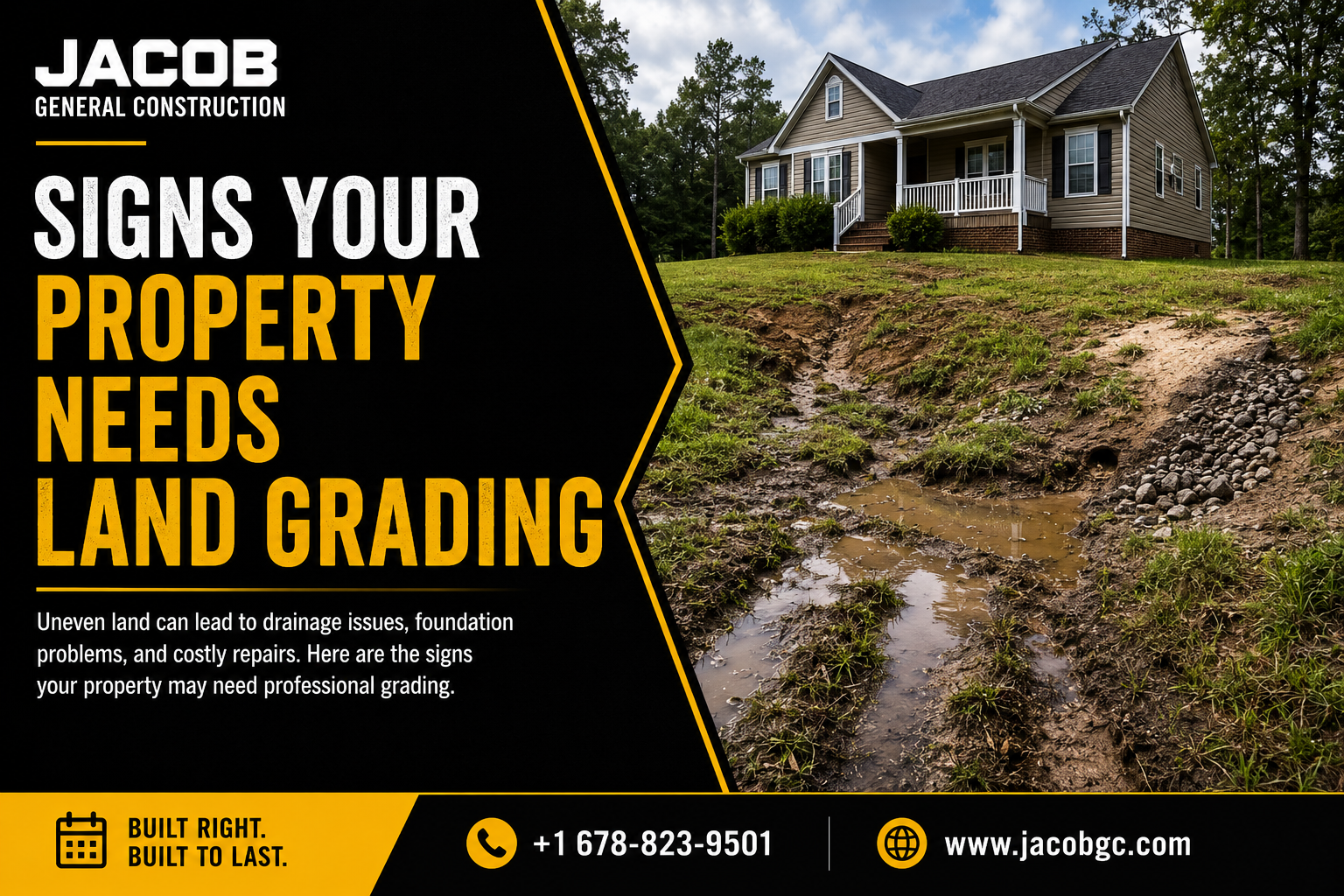
Most homeowners in Milton and Alpharetta don’t think about land grading until something goes wrong — a flooded flower bed, a driveway that’s cracking apart, or water creeping toward the garage after every storm. The truth is, land grading problems rarely show up on day one. They build gradually, often over several rainy seasons, until the signs become impossible to ignore.
Knowing what to look for can save you from years of frustration and thousands of dollars in avoidable repairs. Below, we’ll walk through the most common warning signs that your property needs land grading, why they happen, and what tends to make them worse in North Georgia’s climate and soil.
1. Water Pools Near Your Home After Rain
This is the single most common sign we see. If you notice standing water near your foundation, garage, or crawl space entry point after a rainstorm — and it takes hours (or longer) to drain — your property’s grade isn’t doing its job.
Ideally, the ground around your home should slope away from the foundation at a minimum of about 6 inches over the first 10 feet. When that slope is missing, reversed, or too shallow, water has nowhere to go but toward your house. Over time, that moisture works its way into foundation walls, crawl spaces, and basements, leading to cracking, mold, and structural damage that’s far more expensive to fix than the original grading would have been.
2. Your Yard Has Low Spots or Uneven Ground
Walk your yard after a good rain. If you find soggy patches, small ponds, or areas where grass struggles to grow no matter what you do, you likely have low spots where water collects instead of draining through.
These low spots are often the result of settling, poor original grading, or years of soil erosion moving dirt from higher areas to lower ones. Beyond being an eyesore, standing water in your yard breeds mosquitoes, damages grass and landscaping, and can seep toward your foundation if the low spot is close enough to the house.
3. Your Driveway Is Cracking, Rutting, or Washing Out
Driveways depend heavily on the grade of the ground beneath and around them. If your driveway wasn’t graded correctly to begin with, or if the grading has shifted over time due to erosion, you’ll start to see:
- Cracks running across or along the driveway surface
- Ruts or grooves where water repeatedly flows across it
- Gravel or stone washing to the edges or downhill after storms
- Pooling water at the base of the driveway or near the garage
A driveway sitting on an improperly graded base will keep deteriorating no matter how many times you patch or resurface it. The underlying grade has to be corrected first.
4. Erosion Is Visible on Slopes or Around Your Foundation
If you notice exposed roots, small gullies, or bare patches of dirt on sloped areas of your property, that’s active erosion — and it’s a clear sign that water is moving across your land faster or in a different direction than the grade was designed to handle.
Erosion near your foundation is particularly concerning because it can undermine the soil that’s supporting your home’s footing. Left unaddressed, it tends to get worse with every heavy rain, especially in North Georgia’s clay soil, which erodes differently than sandier soil and can create deep channels over time.
5. The Ground Slopes Toward Your House Instead of Away From It
This one’s easy to miss because it develops gradually — sometimes due to original construction grading that was never quite right, sometimes because of soil settling over the years. If you stand at your foundation and the ground rises as you move outward from the house instead of dropping away, water is being funneled directly at your home every time it rains.
This is one of the more serious grading issues because it puts your foundation at constant risk. It’s also one of the more common issues we’re called out to fix in older Milton and Alpharetta neighborhoods where grading standards or practices have changed since the homes were originally built.
6. You’re Planning New Construction, an Addition, or a Major Landscaping Project
Even if your property doesn’t currently show obvious drainage problems, any of these projects should prompt a grading evaluation first:
- Building a home addition
- Installing a septic system
- Pouring a new driveway, patio, or slab
- Major landscaping or hardscaping work
- Installing a pool
Building on top of ground that hasn’t been properly graded just relocates the problem — usually somewhere more expensive to fix later. It’s far more cost-effective to grade the site correctly before construction begins than to deal with drainage issues after the new structure is in place.
7. Your Yard Is Difficult to Mow, Landscape, or Use
Beyond the drainage concerns, poor grading simply makes a yard frustrating to live with. Awkward slopes, low spots that stay muddy, and uneven terrain make mowing difficult, limit where you can put patios or play areas, and make landscaping an uphill battle — sometimes literally.
If you’ve found yourself avoiding certain parts of your yard because they’re always wet, always muddy, or just awkward to navigate, grading can reshape that space into something usable again.
8. You’re Seeing Foundation Cracks or Basement Moisture
This is the sign that should get immediate attention. Hairline cracks in a foundation, damp basement walls, or a musty smell in a crawl space often trace back to water that’s been sitting against the foundation for months or years due to improper grading. While not every foundation issue is grading-related, it’s one of the first things worth ruling out — and correcting the grade can often stop the problem from getting worse.
Why These Signs Show Up More in North Georgia
Milton and Alpharetta sit on rolling terrain with clay-heavy soil that drains more slowly than sandy or loamy soil. Clay soil holds water longer, which means poorly graded properties in this region tend to show drainage problems faster and more severely than they might elsewhere. That same soil also expands and contracts with moisture changes, which is part of why foundation issues tied to poor drainage are so common in this area.
What to Do If You Recognize These Signs
If any of this sounds familiar, the next step is a professional evaluation — not guesswork or a DIY fix that might make the problem worse. A grading contractor familiar with local soil and terrain can walk your property, identify exactly where water is moving incorrectly, and put together a plan to correct it.
Jacob General Construction has spent over 15 years grading residential properties throughout Milton, Alpharetta, and the surrounding North Georgia area. We know this soil, this terrain, and the drainage problems that come with both. If you’re seeing any of the signs above, call us at 678-823-9501 for a free grading evaluation.
Frequently Asked Questions
1. How do I know if my drainage problem is a grading issue or something else?
If water is consistently pooling in the same spots after rain, moving toward your house instead of away, or your yard has visible low spots, grading is almost always at least part of the problem. A site visit can confirm whether regrading alone will solve it or if additional drainage solutions are needed.
2. Can I fix minor grading issues myself?
Small, isolated low spots can sometimes be improved with topsoil and careful leveling. However, grading problems near a foundation, driveway, or septic system usually require professional equipment and grading expertise to correct properly and avoid making drainage worse.
3. How much does it cost to regrade a yard?
Costs depend on the size of the area, how severe the grading problem is, and how much fill dirt or excavation is needed. We provide free on-site estimates so you know the scope and cost before committing.
4. Will regrading my yard damage my landscaping?
Some existing landscaping near the affected area may need to be temporarily removed or adjusted, but a good contractor will work with you to minimize disruption and can often help restore or replant afterward.
5. How urgent is it to fix a grading problem near my foundation?
This should be treated as a priority. Water sitting against a foundation for an extended period can lead to cracking, moisture intrusion, and more costly structural repairs. The longer it’s left unaddressed, the more expensive the eventual fix tends to be.
6. Does regrading help with erosion on slopes?
Yes. Regrading, sometimes combined with other erosion control methods, redirects water flow so it moves in a controlled way rather than cutting new channels down a slope every time it rains.
7. How long does regrading take for an average residential yard?
Most residential regrading projects take a few days to about a week, depending on the size of the area and the extent of the correction needed. We provide a clear timeline as part of your estimate.
8. Is grading a one-time fix, or does it need to be maintained?
Properly done grading is a long-term fix, but soil does settle and shift over time, especially in clay-heavy areas like Milton and Alpharetta. Periodic checks, especially after major landscaping changes or extreme weather, can catch small issues before they become bigger ones.
Article Comments (0)