

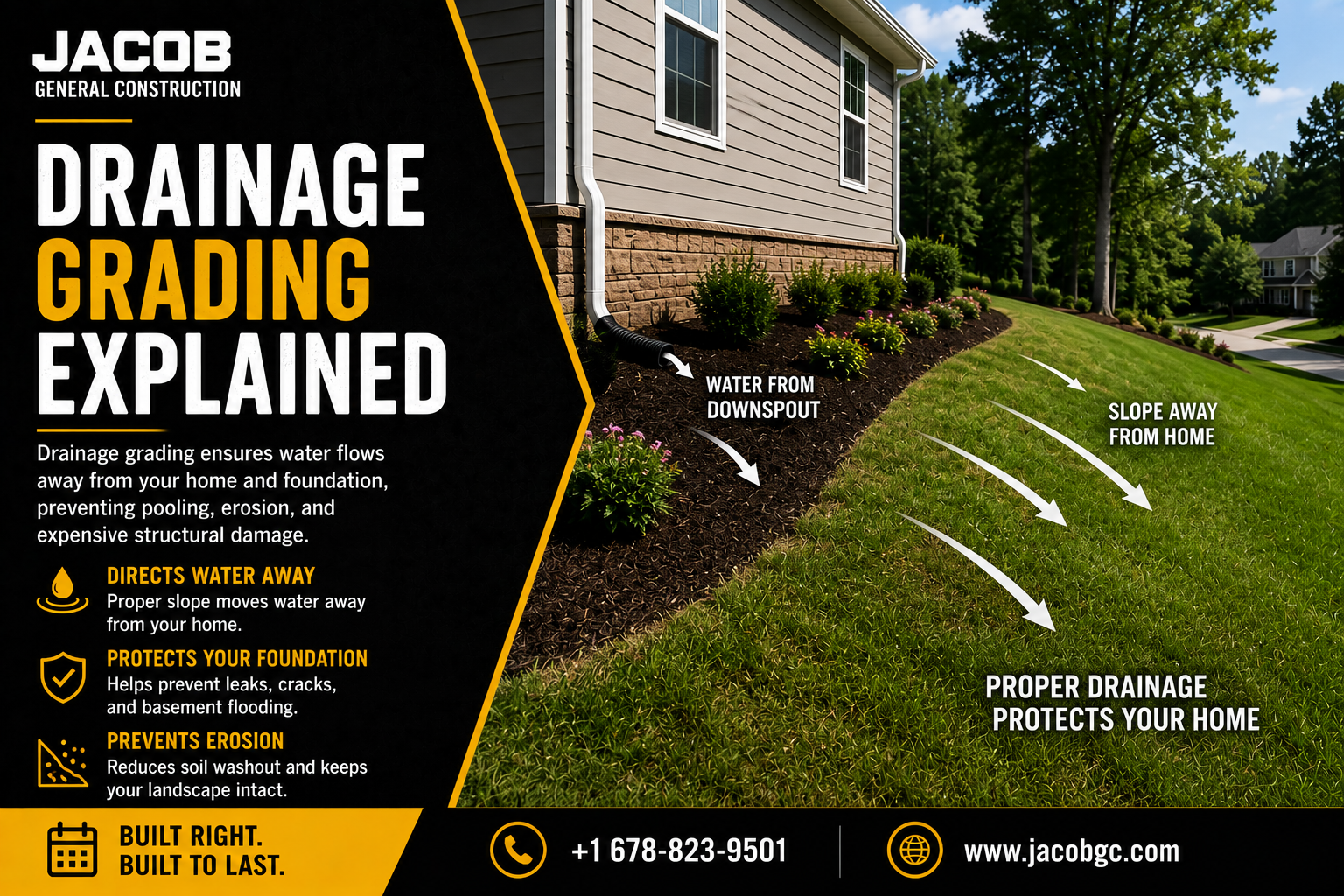
If you’ve dealt with a soggy yard, water creeping toward your foundation, or a driveway that turns into a small river every time it rains, you’ve probably heard the term “drainage grading” thrown around as the fix. But what does that actually mean, and how does it work? For homeowners in Milton and Alpharetta dealing with North Georgia’s clay soil and rolling terrain, understanding drainage grading can help you make informed decisions about protecting your property.
This guide breaks down exactly what drainage grading is, how it works, and why it’s one of the most effective long-term solutions for water problems on residential properties.
What Is Drainage Grading?
Drainage grading is the process of shaping the land on a property — cutting, filling, and sloping the ground — specifically to control how water moves across it. Unlike general grading, which might focus on creating a flat building pad or a usable yard, drainage grading is centered entirely on one goal: getting water to move away from structures and toward appropriate drainage points instead of pooling, pushing against a foundation, or eroding the landscape.
At its core, drainage grading relies on a simple principle: water always follows the path of least resistance downhill. The job of proper grading is to make sure that path leads somewhere safe — a swale, a drain, a lower area of the property, or the street — rather than toward your home, garage, or driveway.
The Science Behind Proper Drainage Slope
There’s a specific, well-established standard for drainage grading around residential foundations: the ground should slope downward at a minimum of 6 inches over the first 10 feet away from the structure, which works out to roughly a 5% grade. This isn’t arbitrary — it’s the minimum slope needed to reliably move rainwater away from a foundation before it has time to soak into the surrounding soil and create hydrostatic pressure against foundation walls.
Beyond that immediate zone around the foundation, drainage grading typically continues at a gentler but still deliberate slope across the rest of the property, guiding water toward its final destination without creating erosion or uncontrolled runoff along the way.
How Drainage Grading Differs From Other Types of Grading
It’s worth distinguishing drainage grading from other grading concepts you might encounter:
- Land leveling focuses on making a specific area flat for a particular use, without necessarily addressing broader water flow
- Site grading for new construction focuses on preparing a building pad and overall lot shape, with drainage as one component among several
- Drainage grading specifically targets water management as the primary objective, whether that’s correcting an existing problem or designing water flow into a new site from the start
In practice, these often overlap — site grading for new construction includes drainage grading principles, and correcting a drainage problem on an existing property often involves some leveling of specific areas. But when drainage is the primary concern, it should be the primary focus of the grading plan, not an afterthought.
Why North Georgia Properties Need Careful Drainage Grading
Milton and Alpharetta present a specific combination of conditions that make drainage grading especially important:
Clay-heavy soil. Red clay, common throughout this part of Georgia, absorbs water much more slowly than sandy or loamy soil. When drainage grading isn’t done correctly, water sits on the surface or just beneath it for extended periods rather than draining through the soil relatively quickly. That prolonged saturation is what leads to the most serious problems — foundation pressure, erosion, and persistent standing water.
Rolling terrain. Much of the region isn’t flat, which means water naturally wants to move downhill across a property. Without proper grading to control that flow, water can gain speed and volume as it moves, leading to erosion and concentrated flow toward whatever happens to be at the bottom of the slope — often a home, garage, or neighboring property.
Heavy seasonal rainfall. Georgia’s rainy seasons put drainage grading to the test regularly. A grading job that looks fine on a dry day can reveal serious flaws the first time a heavy storm rolls through.
Common Drainage Grading Techniques
Sloped Grading Away From Structures
The most fundamental technique: shaping the ground so it consistently slopes away from foundations, garages, and other structures, following the minimum standard mentioned earlier.
Swales
A swale is a shallow, graded channel designed to direct water flow along a specific path, typically toward a drain, retention area, or the street. Swales are often used where a natural low point needs a controlled way to move water without creating a ditch that’s difficult to mow or maintain.
Cut and Fill Balancing
On uneven lots, drainage grading often involves cutting soil from high points and using it to fill low points, creating a more consistent and predictable slope across the property rather than leaving isolated high and low areas that disrupt water flow.
Directing Water to Appropriate Outlets
Effective drainage grading always considers where water ends up. Redirecting water away from a foundation only solves half the problem if it simply creates a new issue somewhere else on the property or on a neighboring lot. Proper drainage grading plans account for a clear, appropriate final destination for the water being redirected.
Signs Your Property Needs Drainage Grading
- Water pools near your foundation, garage, or driveway after rain and takes a long time to drain
- Your yard has consistently soggy or muddy patches
- You notice erosion, exposed roots, or small channels forming on sloped areas
- Water appears to be flowing toward your home rather than away from it
- Your basement or crawl space shows signs of moisture or dampness after rain
- Your driveway floods or develops ruts and washouts
What a Drainage Grading Evaluation Looks Like
When we evaluate a property for drainage grading, we look at several factors together rather than in isolation:
- Existing slope and elevation changes across the property
- Where water is currently pooling or flowing incorrectly, ideally observed during or right after rain
- Soil conditions, since clay-heavy soil requires different grading considerations than sandier soil
- Structures and obstacles that need to be worked around, including the home, driveway, septic system, and landscaping
- Appropriate drainage outlets available on or near the property
This evaluation shapes a grading plan that addresses the specific way water is currently moving incorrectly on your property, rather than applying a generic fix.
Drainage Grading Alone vs. Combined Drainage Solutions
In many cases, regrading the land is sufficient to solve a drainage problem entirely. In others, drainage grading works best when combined with additional solutions like French drains, catch basins, or gutter and downspout extensions that manage water from the roof separately from surface water across the yard. A thorough evaluation should identify whether grading alone will solve your specific issue or whether a combined approach makes more sense.
The Cost of Ignoring Drainage Grading Problems
Water problems rarely stay the same size. A minor pooling issue near a foundation today can lead to foundation cracking, crawl space moisture, and mold within a few years if left unaddressed. A yard that holds water in one corner can develop worsening erosion with each storm. Addressing drainage grading proactively is almost always significantly less expensive than dealing with the structural or moisture damage that develops when it’s ignored.
Get a Drainage Grading Evaluation
Jacob General Construction has spent over 15 years correcting drainage problems through professional grading for homeowners throughout Milton, Alpharetta, and the surrounding North Georgia area. We understand how this region’s clay soil and terrain affect water flow, and we build every drainage grading plan around your property’s specific conditions. Call us at 678-823-9501 for a free evaluation.
Frequently Asked Questions
1. What’s the difference between drainage grading and regular grading?
Regular grading can serve various purposes, like leveling ground or preparing a building pad. Drainage grading specifically focuses on controlling how water moves across a property, with directing water away from structures as the primary goal.
2. How much slope do I need for proper drainage around my foundation?
The standard minimum is a 6-inch drop over the first 10 feet away from the foundation, roughly a 5% grade. This is generally enough to reliably move water away before it saturates the soil against foundation walls.
3. Can drainage grading fix a wet crawl space or basement?
In many cases, yes, particularly if the moisture is caused by surface water and poor grading rather than groundwater issues. Correcting the grade so water flows away from the foundation addresses one of the most common causes of crawl space and basement moisture.
4. Do I need drainage grading if my yard looks flat?
Possibly. A yard can look relatively flat to the eye while still having subtle slope problems that direct water toward a house or create pooling. A professional evaluation, ideally during or after rain, can identify these issues even on seemingly flat lots.
5. How does clay soil affect drainage grading?
Clay soil absorbs water much more slowly than sandy soil, meaning water sits on the surface longer if grading isn’t done correctly. This makes proper slope and drainage planning especially important on North Georgia’s clay-heavy properties.
6. Will drainage grading solve erosion problems on a slope?
Often, yes, particularly when erosion is caused by uncontrolled water flow. Grading can redirect that flow along a controlled path, sometimes combined with a swale, to prevent water from carving new channels down the slope.
7. How long does a drainage grading project typically take?
Most residential drainage grading projects take anywhere from a few days to about a week, depending on the size of the affected area and the extent of correction needed.
8. Is drainage grading a permanent fix, or will the problem come back?
Properly done drainage grading is designed as a long-term solution, but soil does settle over time, especially clay soil common in Milton and Alpharetta. Periodic checks after major storms or landscaping changes help catch small shifts early.
9. Do I need additional drainage solutions besides grading?
Sometimes. While grading alone solves many drainage problems, more severe or complex situations may benefit from additional solutions like French drains or catch basins working alongside the graded slope.
10. How do I know if my drainage problem is severe enough to need professional grading?
If water is consistently pooling near your foundation, taking a long time to drain, or you’re seeing signs of erosion or moisture intrusion, it’s worth getting a professional evaluation rather than waiting for the problem to worsen.
Article Comments (0)