

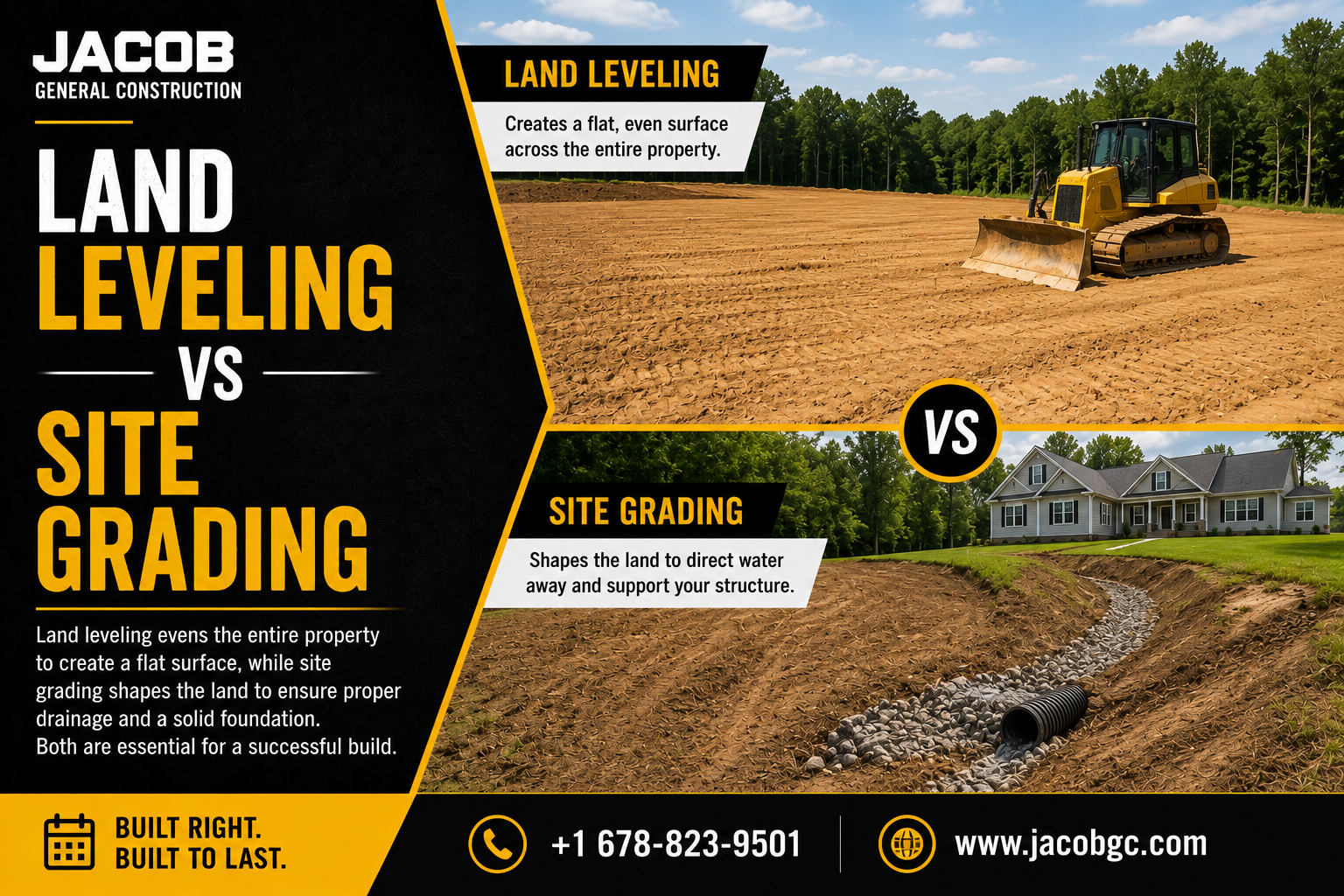
If you’ve started researching options for improving your property in Milton or Alpharetta, you’ve probably run into two terms that sound similar but describe different things: land leveling and site grading. Homeowners often use them interchangeably, and it’s easy to see why — both involve reshaping the ground with heavy equipment. But confusing the two can lead to the wrong work being done for your actual goal, which either wastes money or leaves your original problem unsolved.
Understanding the difference matters because it directly affects the outcome you’re trying to achieve, whether that’s a flat backyard for entertaining, a stable pad for new construction, or a property that finally drains the way it should.
What Land Leveling Actually Means
Land leveling is exactly what it sounds like: making a specific area of ground flat, or as close to flat as the intended use requires. It’s typically done for:
- Preparing a spot for a shed, playset, or outdoor structure
- Creating a flat area for a garden, patio, or sports court
- Leveling ground for laying new sod
- Making a specific section of yard usable for a particular purpose
Land leveling focuses on a defined area and a specific outcome: flat, usable ground. It doesn’t necessarily account for how water moves across the broader property — the goal is flatness for a purpose, not drainage management for the whole site.
What Site Grading Actually Means
Site grading is a broader, more technical process that shapes the land — often across an entire property or building lot — to control drainage, create stable building pads, and establish the right elevations relative to structures, driveways, and drainage points.
Site grading typically involves:
- Establishing slope away from a home’s foundation
- Cutting and filling to balance high and low areas across a lot
- Creating a stable, compacted base for construction (a building pad, driveway, or patio)
- Directing water toward appropriate drainage points like swales, drains, or the street
- Preparing land ahead of septic system installation
Unlike land leveling, site grading isn’t about making everything flat. In fact, a well-graded site usually isn’t flat at all — it has carefully calculated slopes designed to move water in a specific direction. Grading is about controlling elevation and drainage across the whole picture, not just flattening one section.
The Key Difference: Purpose
The clearest way to think about the distinction is purpose:
- Land leveling = making a specific area flat for a specific use
- Site grading = shaping land (which may include some flat areas) to control drainage, stability, and elevation across a property or building site
A flat backyard achieved through leveling might look great, but if it doesn’t account for where water goes during a storm, you could end up creating a new drainage problem rather than solving one. This is a mistake we see often — a homeowner levels a section of yard without considering the broader slope of the property, and ends up with a flat area that now holds water because it no longer has anywhere to drain.
Site grading, on the other hand, is designed with drainage as a core consideration from the start. It’s why professional grading plans account for the whole property’s topography, not just the specific area a homeowner wants improved.
When You Need Land Leveling
Land leveling is usually the right call when:
- You want to install a shed, swing set, or other backyard structure that requires a flat base
- You’re preparing a small, defined area for a patio or garden bed
- You’re laying new sod and want an even surface for it to establish properly
- The area in question is relatively small and isolated from broader drainage concerns
When You Need Site Grading
Site grading is the right approach when:
- You’re preparing land for new home construction or an addition
- You have drainage problems — water pooling, erosion, or flow toward your foundation
- You’re installing a septic system, which depends heavily on proper grading and soil drainage
- You’re dealing with an uneven lot that needs cut-and-fill work to balance elevations
- You’re planning a driveway, and need the base properly sloped for longevity and drainage
- Your property has significant slope or terrain challenges common throughout Milton and Alpharetta
Why This Distinction Matters in North Georgia
Milton and Alpharetta properties often combine two challenging factors: rolling terrain and clay-heavy soil. That combination means drainage problems are common, and they tend to get worse if the wrong type of earthwork is applied to the situation.
If a property has a genuine drainage issue — water pooling near the foundation, erosion on a slope, or runoff causing damage — simply leveling the affected area without addressing the surrounding grade often makes things worse, not better. The water still needs somewhere to go; leveling alone doesn’t solve that, it just removes the slope that was (however imperfectly) directing it somewhere.
This is why a professional evaluation matters before committing to either type of work. What looks like “the yard just needs to be leveled” is very often actually a grading problem that requires a broader plan.
Can a Project Involve Both?
Yes, frequently. Many residential projects use both techniques together. For example, when preparing land for a new home, site grading establishes the correct building pad elevation and overall drainage pattern for the lot, while land leveling might be used afterward for smaller finished areas like a patio pad or a flat section for landscaping.
Similarly, if you’re regrading a yard to fix a drainage issue, the final step often includes leveling specific areas — like where new sod will go — once the broader grading correction is complete. The grading solves the drainage problem; the leveling makes the finished result look and function well for everyday use.
How to Know Which One You Actually Need
If your primary concern is drainage — water pooling, erosion, moisture near your foundation, a driveway that’s failing — you need site grading, even if a leveled surface is also part of the eventual outcome. If your primary goal is simply a flat area for a specific structure or use, and there’s no underlying drainage concern, land leveling alone may be sufficient.
When in doubt, it’s worth having a contractor walk the property and evaluate the broader slope and drainage pattern before starting any work. What seems like a simple leveling job can sometimes reveal a grading issue that would have caused problems down the road if left unaddressed.
Get the Right Assessment for Your Property
Jacob General Construction has spent over 15 years handling both land leveling and full site grading projects for homeowners throughout Milton, Alpharetta, and the greater North Georgia area. We’ll walk your property, assess what you’re actually dealing with, and recommend the approach that solves the problem — not just the one that sounds simpler. Call us at 678-823-9501 for a free evaluation.
Frequently Asked Questions
1. Is land leveling cheaper than site grading?
Generally, yes, because land leveling typically covers a smaller, more defined area and doesn’t require the same level of drainage planning as full site grading. However, cost depends on the size and condition of the area involved.
2. Can leveling my yard fix a drainage problem?
Not usually, and it can sometimes make things worse. Leveling removes slope, which can eliminate the natural path water was using to drain, leaving standing water with nowhere to go. Drainage problems typically require site grading, not simple leveling.
3. Do I need site grading before building a shed?
For most sheds, land leveling is sufficient to create a flat, stable base. Site grading becomes necessary if the area has drainage issues or if the shed’s location affects water flow toward your home or neighboring property.
4. How do I know if my yard needs grading instead of leveling?
If you’re dealing with standing water, erosion, or water flowing toward your foundation, you need grading. If you simply want a flat area for a specific use and there’s no drainage concern, leveling is likely enough.
5. Does new home construction require both leveling and grading?
Often, yes. Site grading establishes the overall building pad and drainage pattern for the lot, while leveling may be used for specific finished areas like patios or landscaped sections once the main grading work is complete.
6. Can I level my own yard with rented equipment?
Small, isolated leveling projects (like a spot for a shed) are sometimes manageable as a DIY project. However, if the area is near your foundation, driveway, or septic system, or if there’s any drainage consideration, professional grading is strongly recommended.
7. Will land leveling affect drainage on the rest of my property?
It can, especially if the leveled area was previously part of the natural drainage path. This is why it’s important to consider the broader property slope before leveling a specific section, particularly on properties with the rolling terrain common in Milton and Alpharetta.
8. Which service should I call for first: grading or leveling?
Start with a professional evaluation rather than assuming which service you need. A contractor who offers both can assess your property and recommend the right approach, which sometimes turns out to be a combination of the two.
Article Comments (0)