

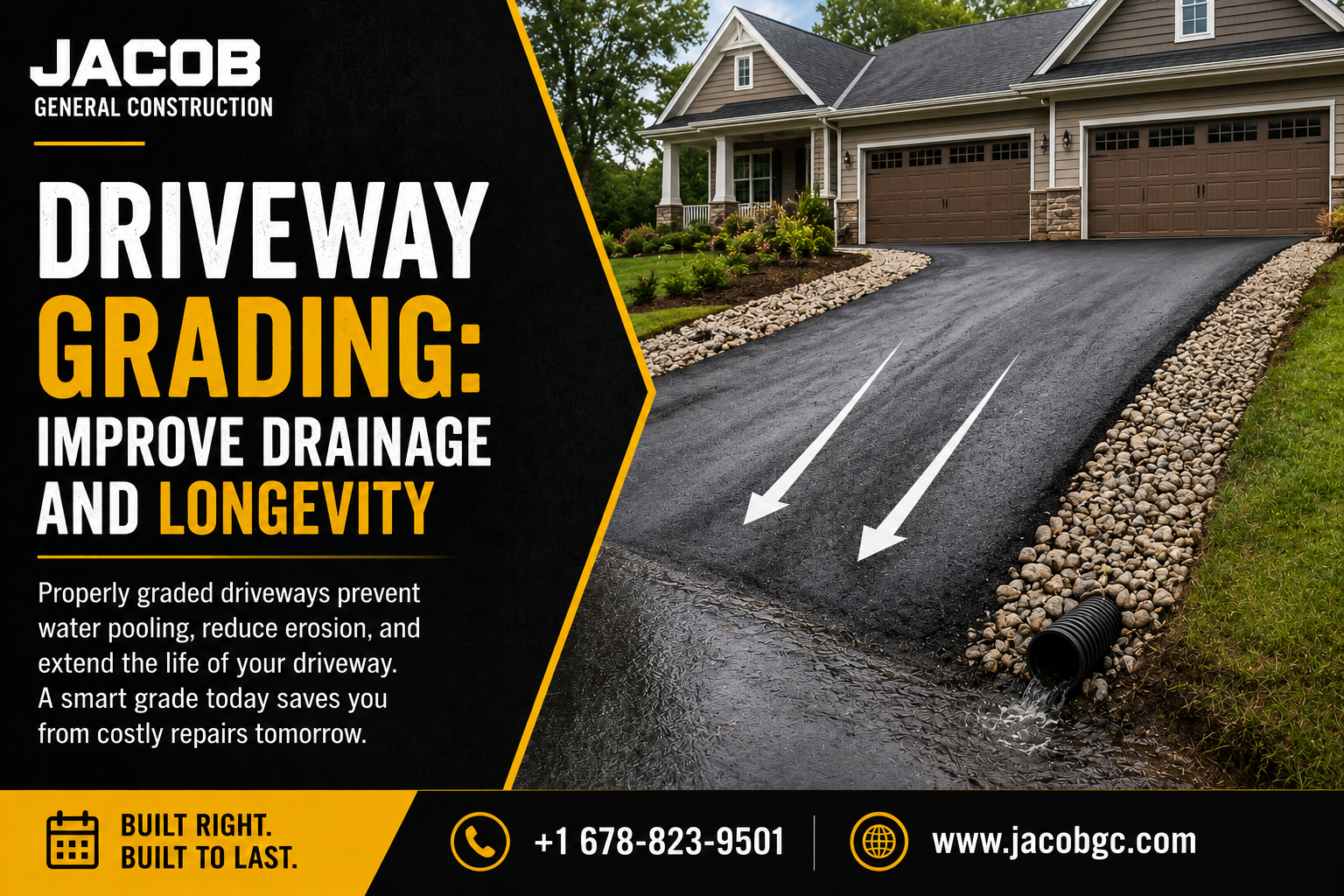
A driveway is one of the most heavily used surfaces on any property, and it takes a beating — vehicle weight, weather, seasonal freezing and thawing, and constant water exposure. What most homeowners in Milton and Alpharetta don’t realize is that a driveway’s biggest enemy isn’t usually the surface material itself. It’s what’s underneath it. Without proper driveway grading, even a well-poured concrete or asphalt driveway will crack, rut, and deteriorate long before it should.
If you’re dealing with a driveway that’s washing out, cracking, or pooling water, or you’re planning a new driveway installation, understanding driveway grading — and why it matters as much as the surface material — can save you a significant amount of money and frustration over the life of the driveway.
What Driveway Grading Actually Does
Driveway grading is the process of shaping the ground beneath and around a driveway so it has a stable, properly sloped base before any gravel, asphalt, or concrete goes down. The goal is twofold: create a base that can support the weight of vehicles without shifting or settling unevenly, and establish a slope that moves water off the driveway surface and away from your home, garage, and surrounding landscaping.
Done correctly, driveway grading includes:
- Sub-base preparation — removing unstable soil, organic material, and debris, then compacting a stable base layer
- Cross-slope grading — sloping the driveway surface slightly from side to side (or crowned in the middle) so water runs off rather than pooling
- Longitudinal grading — managing the slope along the length of the driveway, especially important on sloped lots
- Drainage integration — tying the driveway’s runoff into swales, drains, or other drainage points so water doesn’t just relocate to another problem area
Skipping or rushing any of these steps is one of the most common reasons driveways fail well before their expected lifespan.
Why Poor Driveway Grading Leads to Expensive Problems
When a driveway is installed on a base that wasn’t properly graded and compacted, a predictable series of problems tends to follow:
Cracking and settling. An unstable or unevenly compacted base shifts under the weight of vehicles over time. Concrete and asphalt aren’t flexible enough to handle that movement without cracking.
Standing water and puddles. If the driveway doesn’t have a proper cross-slope, water collects in low spots on the surface instead of running off. Over time, that standing water works its way into small cracks, freezes and expands in colder months, and accelerates surface deterioration.
Erosion along the edges. Without proper grading to control runoff, water can wash out the gravel or soil along the edges of a driveway, undermining the surface from the sides.
Water directed toward your home or garage. This is one of the more serious consequences. A driveway that slopes the wrong way — toward the house instead of away from it — can direct significant amounts of water toward your garage or foundation every time it rains.
Ruts and washouts on gravel driveways. For gravel driveways especially, poor grading means water repeatedly follows the same path down the drive, cutting ruts that get deeper and harder to maintain with each storm.
Driveway Grading and North Georgia Terrain
Milton and Alpharetta have plenty of properties with sloped lots, which makes driveway grading even more critical than it would be on flat terrain. A driveway running downhill toward a garage or house needs careful grading to control water speed and direction — otherwise, every heavy rain sends water rushing toward the home instead of dispersing it safely.
North Georgia’s clay soil adds another layer to this. Clay compacts differently than sandier soils and drains more slowly, which means a driveway base built on clay needs to be graded and compacted correctly from the start, or it will hold water beneath the surface and lead to soft spots, cracking, and premature failure.
Signs Your Driveway Needs Regrading
If you’re seeing any of the following, the underlying grade is likely at least part of the problem — not just the surface material:
- Cracks running across or lengthwise down the driveway
- Puddles or standing water that don’t drain quickly after rain
- Gravel or stone that keeps washing to the edges or downhill
- Ruts, grooves, or channels forming in a gravel driveway
- Water pooling near the garage door or flowing toward the house
- Visible dips or low spots in the driveway surface
- Edges of the driveway eroding or separating from the surrounding yard
Patching or resurfacing a driveway without correcting the underlying grade is a short-term fix. The same problems tend to reappear within a season or two because the root cause — an improperly graded base — was never addressed.
New Driveway Installation: Get the Grading Right the First Time
If you’re planning a new driveway, whether for new construction or replacing an existing one, driveway grading should be the first conversation you have with your contractor — before any discussion of surface material, finish, or design.
A proper grading plan for a new driveway takes into account:
- The natural slope of the lot and how it affects water flow
- Where water needs to be directed once it leaves the driveway surface
- The weight the driveway will need to support (passenger vehicles versus larger trucks or equipment)
- How the driveway ties into existing drainage, landscaping, and the garage or home entrance
- Soil conditions and how much sub-base preparation is needed
Getting this right before the concrete or asphalt goes down means you’re not paying to fix drainage and structural problems a few years later.
Driveway Longevity Starts Below the Surface
It’s worth repeating: the surface material of a driveway is only as good as what’s underneath it. A beautifully finished concrete driveway poured on an improperly graded base will still crack and settle. A well-graded base under a simple gravel driveway will outperform a poorly graded base under premium material every time.
This is why, at Jacob General Construction, we look at driveway work as a grading project first and a surface installation second. We shape and compact the base to the correct slope and stability standards, then build the driveway surface on top of a foundation that’s actually going to hold up.
When Regrading Makes More Sense Than Resurfacing
If your driveway has ongoing drainage or cracking issues, it’s worth having a contractor evaluate whether the underlying grade needs correction before investing in a new surface. In many cases, regrading the base — sometimes combined with improved drainage solutions like swales or French drains along the edges — solves the problem permanently, whereas resurfacing alone just delays the same issue from coming back.
Get Your Driveway Graded Right
Jacob General Construction has spent over 15 years grading driveways for homeowners throughout Milton, Alpharetta, and the surrounding North Georgia area. Whether you’re dealing with a failing driveway or planning a new one, we build every grading plan around the slope, soil, and drainage conditions specific to your property. Call us at 678-823-9501 for a free driveway grading estimate.
Frequently Asked Questions
1. Why does my new driveway already have cracks and standing water?
This almost always points back to the base it was installed on. If the sub-base wasn’t properly graded, compacted, and sloped before the surface material went down, cracking and drainage problems tend to show up within the first year or two.
2. What’s the ideal slope for a driveway to drain properly?
Most residential driveways use a cross-slope (side to side) or crown design of about 1-2% to move water off the surface, along with careful grading along the length of the driveway to control water flow, especially on sloped lots.
3. Can driveway grading fix water pooling near my garage?
In most cases, yes. If water is collecting near your garage door, it usually means the driveway is sloped toward the structure instead of away from it. Regrading corrects the direction of flow so water moves away from the garage and house.
4. Do I need to regrade before installing a new driveway?
Yes, if the existing ground hasn’t already been properly graded. Skipping this step and simply pouring a new surface over an unprepared base is one of the most common reasons new driveways fail early.
5. How does North Georgia’s clay soil affect driveway grading?
Clay soil compacts and drains differently than sandy soil, and it can hold water beneath the surface if not properly graded and compacted. This makes correct grading especially important for driveways in Milton and Alpharetta.
6. Will regrading fix ruts and washouts on my gravel driveway?
Yes. Ruts and washouts on gravel driveways are caused by water repeatedly following the same uncontrolled path. Regrading corrects the slope so water disperses properly instead of carving deeper channels with each rain.
7. How long does driveway grading take?
For most residential driveways, grading takes a day or two, depending on the length of the driveway, the extent of correction needed, and site access. We provide a clear timeline as part of your estimate.
8. Is it cheaper to resurface my driveway or regrade it?
Resurfacing without addressing an underlying grading problem is usually a short-term fix, since the same cracking and drainage issues tend to return. Regrading first, even though it may cost more upfront, typically saves money over the life of the driveway.
Article Comments (0)