

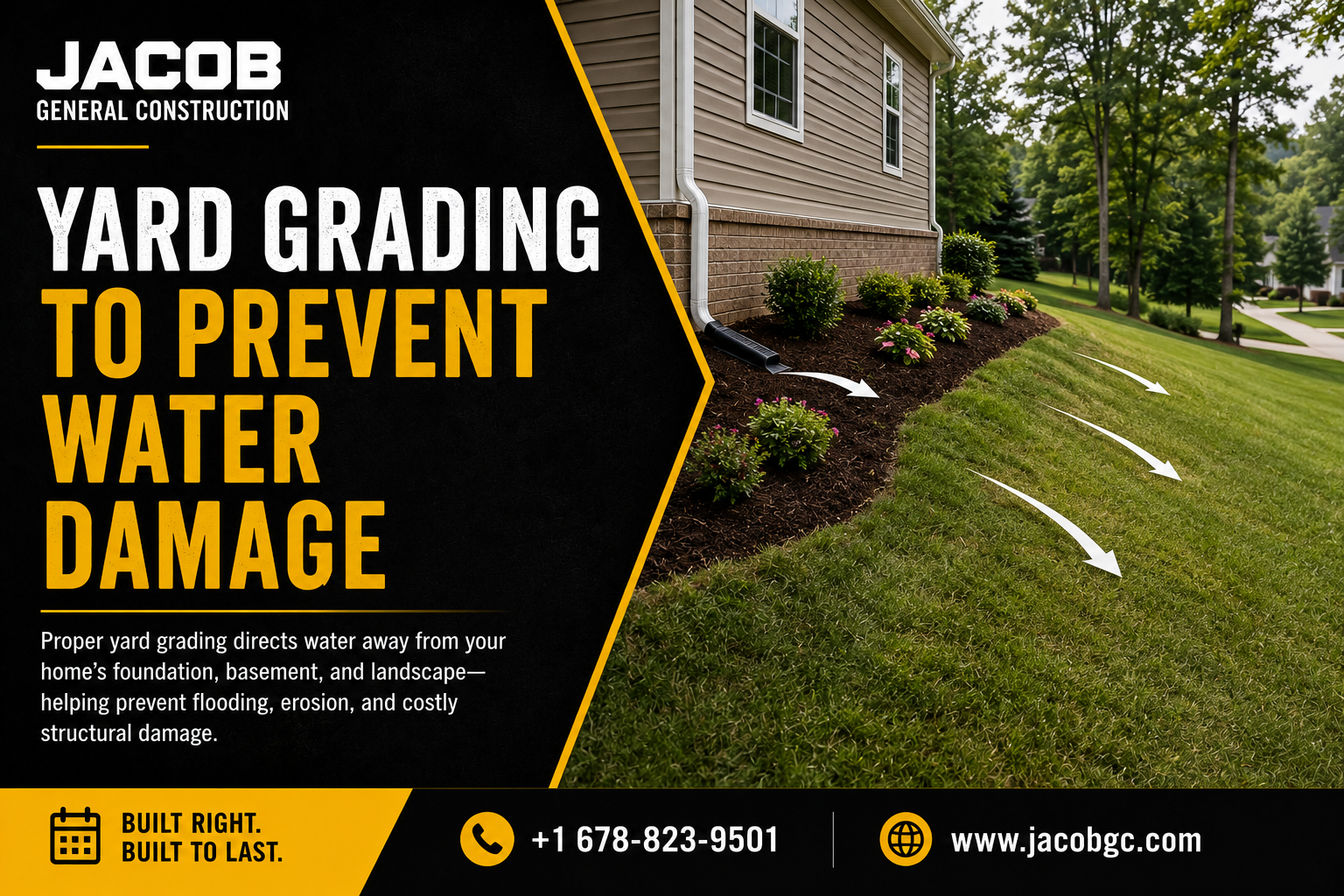
Water damage rarely announces itself all at once. It starts small — a damp patch in the crawl space, a musty smell after a rainy week, a corner of the yard that’s always a little too soft underfoot. By the time it’s obvious, the fix is usually bigger and more expensive than it needed to be. In most cases, the root cause traces back to one thing: yard grading that isn’t moving water where it should.
For homeowners in Milton and Alpharetta, yard grading isn’t a cosmetic upgrade — it’s one of the most effective ways to protect your home’s foundation, crawl space, and landscaping investment from long-term water damage. Here’s how it works, why it matters so much in North Georgia, and what a proper grading correction actually involves.
How Yard Grading Prevents Water Damage
Grading is the slope and shape of the ground across your property. A well-graded yard is built so rainwater flows away from your home’s foundation and toward appropriate drainage points — a swale, a drain, a lower area of the yard, or the street — instead of collecting near the house or in low spots across the lawn.
When grading is done correctly, water has a clear path to follow every time it rains. When it’s not — because the original grading was never right, because soil has settled over the years, or because landscaping changes disrupted the slope — water starts pooling in places it shouldn’t. That’s when water damage starts working its way into your home.
The consequences of poor yard grading typically show up in a predictable sequence:
- Water begins pooling near the foundation or in low spots in the yard
- Saturated soil pushes against foundation walls (hydrostatic pressure)
- Moisture works its way into crawl spaces, basements, or slab edges
- Mold, mildew, and wood rot start developing in affected areas
- Foundation cracking or settling becomes a genuine structural concern
Catching this cycle early — ideally before it starts — is a lot cheaper than addressing it once it’s reached your crawl space or foundation walls.
The Slope Standard That Actually Matters
There’s a specific benchmark worth knowing: the ground immediately around your foundation should slope downward at least 6 inches over the first 10 feet, which works out to roughly a 5% grade. This isn’t a suggestion — it’s the standard used in residential construction because it reliably moves water away from the slab before it has time to soak into the surrounding soil.
If you’re not sure whether your yard meets that standard, a simple way to check is to watch what happens during and immediately after a rainstorm. If water is sitting near your foundation more than a few minutes after the rain stops, or if you can visibly see the ground sloping toward the house rather than away from it, your yard likely needs regrading.
Why This Is Especially Important in North Georgia
Milton and Alpharetta sit on clay-heavy red soil that behaves very differently from sandy or loamy soil found elsewhere. Clay soil absorbs water slowly, which means when grading fails to move water away efficiently, that water tends to sit on the surface or just below it for much longer than it would in other soil types.
That extended saturation period is exactly what causes the most damage. The longer water sits against a foundation, the more hydrostatic pressure builds, and the more likely you are to see cracking, seepage, or long-term structural issues. Combine that with the rolling terrain common throughout this part of North Georgia, and you have a landscape where grading errors are amplified rather than smoothed over naturally.
Common Yard Grading Problems We See
Over 15+ years of grading residential properties throughout North Georgia, a handful of issues come up again and again:
- Reverse slope near the foundation — the ground rises as it moves away from the house instead of dropping, funneling water directly at the structure
- Low spots created by settling — soil compacts unevenly over time, creating depressions that collect water
- Landscaping that disrupted original grading — retaining walls, garden beds, or added soil that unintentionally changed how water flows
- Erosion from years of unmanaged runoff — water repeatedly following the same path has cut channels that make the problem worse with every storm
- Grading that was never correct to begin with — some older homes were built before current grading standards were common practice
Each of these requires a slightly different approach, which is why a proper evaluation matters more than a generic fix.
What a Yard Grading Correction Involves
When we’re called out to correct a drainage problem through regrading, the process typically looks like this:
Site Evaluation
We walk the property, identify where water is currently pooling or flowing incorrectly, and check existing slope, soil condition, and any obstacles — trees, structures, utility lines — that need to be worked around.
Grading Plan
Based on that evaluation, we put together a plan for how the ground needs to be reshaped, including where cut and fill work is needed and where drainage points should direct water once it moves away from the house.
Cut and Fill Work
We use the right equipment to reshape the land — removing soil from high points, adding fill where needed, and compacting properly so the new grade holds up over time rather than settling unevenly again.
Finish Grading and Walkthrough
Once the reshaping is complete, we smooth the final surface, confirm the slope meets proper standards, and walk the site with you to make sure the correction addresses the original problem.
Yard Grading and Landscaping Work Together
One thing we emphasize with every client: grading doesn’t have to come at the cost of a yard you enjoy using. In fact, correcting grading problems often opens up areas of the yard that were previously unusable due to standing water or muddy patches. A properly graded yard drains well and gives you a stable, even base to landscape, plant, or build on — whether that’s new sod, a patio, or a play area for kids.
Don’t Wait for Water Damage to Force the Issue
The homeowners we hear from most often are the ones who’ve already dealt with a wet crawl space, a cracked foundation wall, or a yard that’s essentially unusable after every storm. In nearly every case, the signs were there for a while before the damage became serious. Catching yard grading issues early — pooling water, visible low spots, a slope that seems off — saves you from a much bigger and more expensive repair down the line.
Get Your Yard Evaluated Before the Next Storm
Jacob General Construction has spent over 15 years correcting yard grading and drainage problems for homeowners throughout Milton, Alpharetta, and the greater North Georgia area. We understand how this region’s clay soil and terrain affect drainage, and we build every grading plan to hold up through Georgia’s wet seasons. If your yard is showing signs of poor drainage, call us at 678-823-9501 for a free evaluation.
Frequently Asked Questions
1. How do I know if my yard’s grading is causing water damage to my home?
Watch for standing water near your foundation after rain, damp crawl space or basement walls, musty smells indoors, or visible cracks in your foundation. If water pools close to the house and takes a long time to drain, grading is likely part of the cause.
2. What’s the ideal slope for yard grading near a foundation?
The standard is a minimum 6-inch drop over the first 10 feet away from the foundation — roughly a 5% slope. This is enough to reliably move water away from the structure before it saturates the surrounding soil.
3. Can yard grading alone fix a wet basement or crawl space?
In many cases, yes — especially if the water intrusion is coming from surface runoff rather than groundwater. Correcting the grade so water flows away from the foundation addresses the most common cause of basement and crawl space moisture.
4. How much does yard regrading typically cost?
Cost depends on the size of the yard, how much cut-and-fill work is needed, and the severity of the existing drainage problem. We provide free, detailed estimates after evaluating the property in person.
5. Will regrading damage my existing lawn or landscaping?
Some disruption to grass and landscaping in the affected area is normal during regrading work, but a good contractor minimizes the impact and can help restore the area with new sod or plantings once grading is complete.
6. How long does yard grading take to prevent water damage effectively?
Most residential yard grading projects take a few days to about a week, depending on the size of the yard and the extent of correction needed. We give you a clear timeline upfront.
7. Does North Georgia’s clay soil make yard grading more important?
Yes. Clay soil drains slowly and holds water longer than sandier soil, which means poor grading causes water to sit against your home for longer periods. That extended exposure increases the risk of foundation and moisture damage.
8. Can I regrade my yard myself to save money?
Minor cosmetic leveling might be manageable as a DIY project, but grading that affects drainage near your foundation, driveway, or septic system should be handled by a professional. Incorrect DIY grading can worsen water flow problems instead of fixing them.
9. Is yard grading a permanent solution, or will I need to redo it eventually?
Properly done grading is designed to be a long-term fix, but soil naturally settles over time, especially clay soil common in Milton and Alpharetta. Periodic checks after major storms or landscaping changes help catch small shifts before they become bigger problems.
Article Comments (0)